Led by Kelli Russell Agodon and Donna Vorreyer, a group of poets who used to blog together in the mid-2000s has gathered once again in an effort to revive our blogs and our communal writing space outside of Facebook and Twitter.
I’m not sure about everyone’s motivations, but I find that if I have a community of writers to turn to, I stay motivated to write and share my process with others. The 2016 elections and the onslaught of trolls and bots has left me fatigued with and leery of other social media outlets, and so I return to my own private Idaho on the web–my blog!
Of course, blogging is another form of social media, but on my site, at least, I don’t have ads popping up.
My project for today is to begin writing a sonnet crown based on the seven words the current occupant of the White House has banned from the CDC budget papers. I’m going to begin with the word “vulnerable.”
After finishing another online poetry workshop with fabulous writer, poet, and teacher Jenn Givhan, I find myself still steeped in the creative process.
Jenn’s narrative poetry prompts at Poetry Barn gave me the nudge I needed to start writing about my experiences this past summer on the Camino de Santiago.
I had started writing a prose travelogue about my first pilgrimage in 2015, and had gotten almost three quarters of the way done, but the project derailed after my father’s prolonged illness in 2015 and his passing in April, 2016.
And then the 2016 elections took place.
I found that I couldn’t go back to my prose writing after these personal and societal upheavals. So I returned to Spain to take another long walk, this time with a portion of my father’s ashes in my backpack. These are the poems I’ve been writing.
Because I’m in a poetry writing mode, I’ve stayed quiet on my blog and in my personal life, but in an effort to be a part of a literary and writing community, I’m going to post here more frequently, sharing the books, paintings, and travels that inspire me.
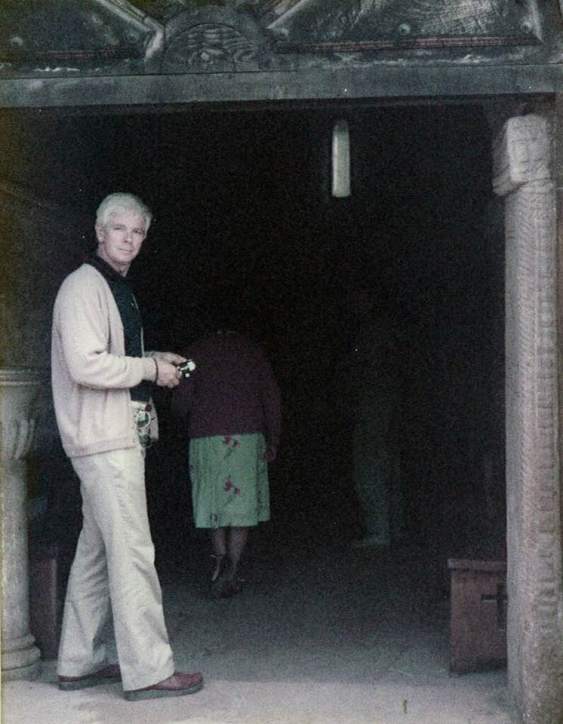
My dad in Spain, 1984. My parents came to visit me at the end of my year of study in Madrid. My mom took the photo. I’m in shadows. All you can see are my legs.
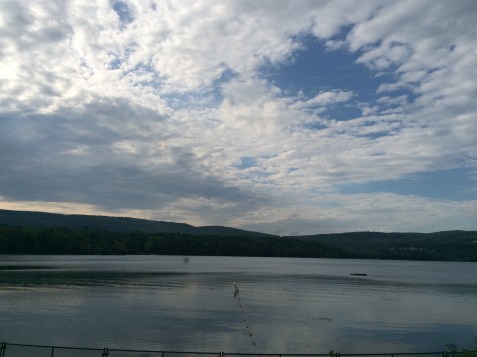
The Stockbridge Bowl, one of my favorite places to swim.
To get myself back into writing, I decided to compile different thoughts about the ocean by female swimmers, most of them open-water swimmers, and put them into a single poem, a kind of collage.
Open Water Swimmer’s Collage
To be in the azure blue as if
You’re breathing. The body, immersed,
Amplified, heavier and
Lighter at the same time.
Looking down miles and miles and miles,
The sea is like a person–like a child
I’ve known a long time.
I never feel alone when I’m out there.
You will forget who you are,
What you did in your life,
And which country you are from.
There’s a knowledge that you
Really are on edge here,
And that you can push yourself too far,
All the way across that vast,
Dangerous wilderness of an ocean.
When I swim in the sea I talk to it.
No matter how rough, cold, or deep,
The water is your friend.
We go in the pitch black of the night.
When we’re in the water,
We’re not in this world. You are a swimmer,
And whoever is next to you
Is a swimmer, too, all of us in the water.
Many of my friends on social media have said they were nauseous after the #RNCinCL ended. In spite of having a two-day headache, I have been reading articles about the orange real estate tycoon, watching Bill Maher (whose opinions I don’t always agree with, especially his puerile views about religion), Steven Colbert, Jon Stewart, and other satirical videos, including this gem by Randy Rainbow, Ya got Trump Trouble!
In an effort to stop my incessant preoccupation with the rhetoric of hatred, I’m taking this online MOOC, Whitman’s Civil War: Writing and Imaging Loss, Death, and Disaster . The course is taught by University of Iowa professors Ed Folsom and Christopher Merrill. We are reading Whitman’s war poems and some of his prose writing and responding with both discussion comments and original work.
I want to write about my father’s death, the loss that is so immediate to me, but I need to connect his dying to these times we are living in: mass shootings in night clubs, elementary schools, and movie theaters, terrorist attacks overseas, the brutality of police toward Black citizens, the deaths of Anton Sterling, Philando Castile, Tamir Rice, Eric Gardner… (the list is too long), the ugly rhetoric of ignorant white supremacists, an arena full of people chanting for the imprisonment of the former Secretary of State.
Whitman wrote for everyone, for all of America. He recognized himself in the fallen soldier, the nurse, the mother saying goodbye to her son.
As a white woman in living the 21st century, how can I recognize myself in the bile coming from the mouths of Trump and his followers? Will I recognize myself in the bodies of Black men left to bleed on the street? To be truly honest with ourselves and to show true compassion, we have to know that we are all interconnected. There is no Us versus Them.
While it comes naturally to me to empathize with the plight of many Black people, I won’t be honest until I look deeply into the hatred coming from a fairly sizable chunk of the white population. Is there any way to transcend this hatred? Poetry and art might be the bridge.
This past April, my father passed away after a six-month illness. It’s too soon for me to write about the experience we went through as a family, but I can talk about my own health.
I had been experiencing early morning anxiety since November, around the time my dad got sick, and then I started waking in the night with panic.
By the end of April my nerves were completely shot and my “fight or flight” response was firing 24/7.
I ended up finding a wonderful doctor whose integrative approach is helping me recover, and in the meantime, I’m spending my mornings practicing gentle yoga on my back porch.
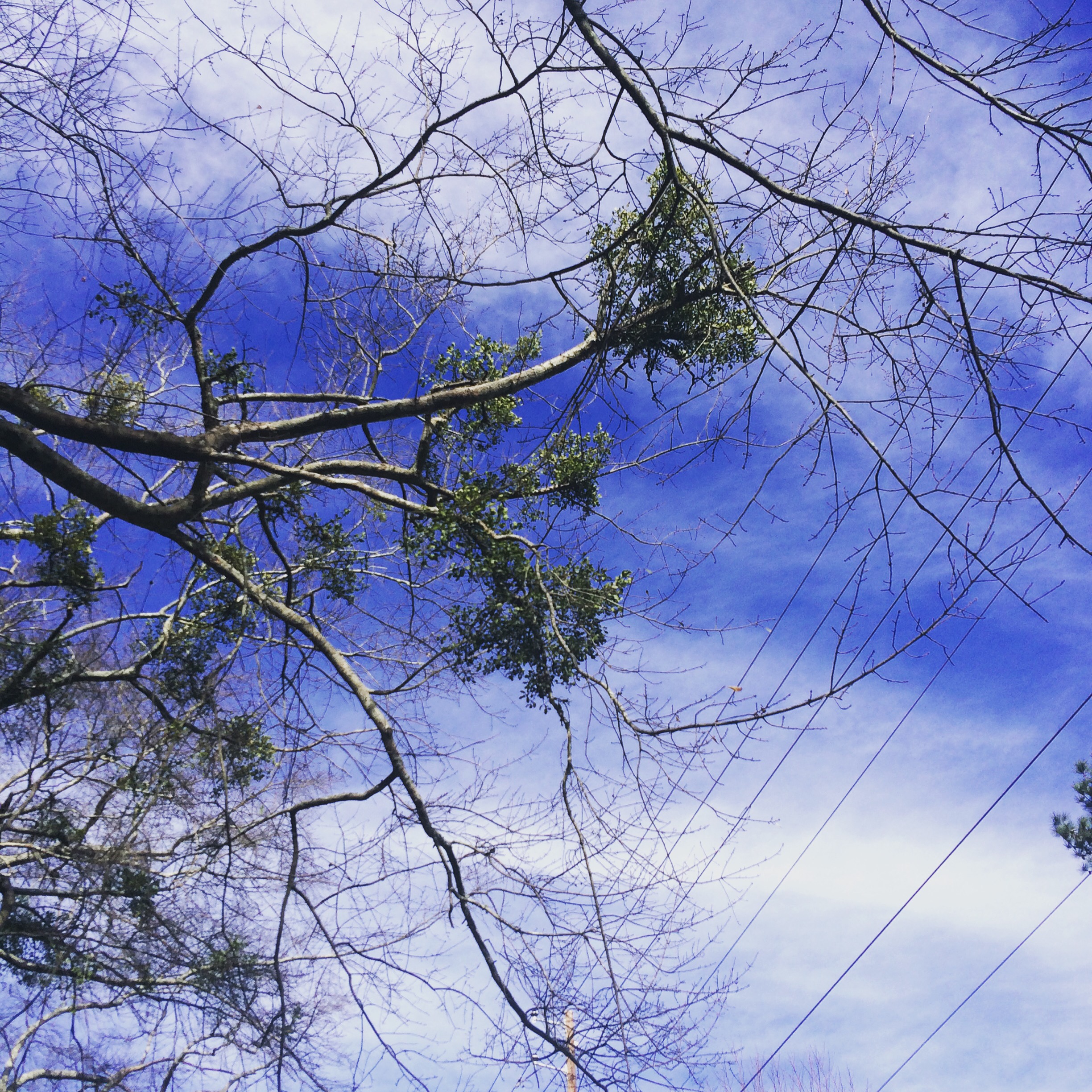
My backyard is completely wild and overgrown, a place that could definitely be tagged as a wildlife refuge in the middle of the suburbs. All I hear in the early morning is the wind in the trees and birdsong.
May we all experience healing and wholeness, the feeling of wellbeing, of feeling safe and secure and at peace.
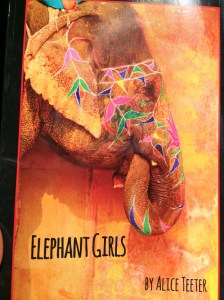
At a recent gathering of the newly formed Atlanta Women’s Poetry Collective, I had the pleasure of meeting Alice Teeter, an Atlanta poet I had known of for quite some time.
Teeter hosts a monthly poetry reading series, a salon that has a reputation for attracting some of the best poets who pass through or live in our city.
Elephant Girls (Aldrich Press, 2015), isAlice Teeter’s third collection of poetry. Didivded into three sections, Elephant Girls explores the myriad facets of the life of the mind and the body, with subjects such as love, desire, imagination, dreams, identity, history, and nature.
The speaker in the poems is fluid, changing from one poem to the next. In “The Sage,” the speaker explores meeting a woman at a conference and the feelings of lust this woman inspires. The speaker states, “her hot hand grasps your thigh,” but later in the poem the woman disappears and the speaker is left with “the person you were born to desire most of all/ the one you have been looking for/spread your hand she is always with you.”
In other poems, such as “The cat didn’t know which she liked best,” the speaker is an animal. In this poem, the cat contemplates which creature pleases her most, the bear or the man.
In this poem and many others, Teeter enters the world of imagination, where possums and skunks enter her car through an open window, a dog paces, alone and afraid, on the Day of the Dead, and big fish “swim like shadows” in dark water.
Teeter delves into the world of carnal pleasure, taking sensual delight in glazed donuts that she compares to “sendal thighs,” thus rendering an indulgence of food into an indulgence of the sensual pleasures of the body.
The stuff of everyday life appears in this collection; even toilet paper makes an appearance. In “Two-Ply,” three rhyming quartets
remember the speaker’s father and his “three-sheet rule.”
The poems in Elephant Girls range from playful to surreal and mythic. The wellspring of this book, full of free verse, sonnets, and other forms, is love-love of family, of the beloved, of lakes, vegetation, of all facets of life that emphasize the joy of being alive.
The writing that my fellow yogis produce after our Saturday yoga class with Sally continues to inspire me.
For our last session, we wrote about our sankalpa, a Sanskritword that means “resolve, intention.” Before meditation, the practitioner visualizes herself having, doing, or being the sankalpa.
Typically, this type of meditation is done before a yoga nidra practice, which involves lying down and mentally naming 54 body parts.
With the body and mind in a state of deep relaxation, yet still awake and conscious, the practioner’s intentions penetrate the deeper layers of consciousness, creating a greater potential for the goals to be realized.
I wrote this intention about how I would like to wake in the morning. I wrote it in the present tense, as if this were my actual waking experience.
I wake in the morning with the first light of day and take a deep breath. My heartspace feels open and soft, and I’m at peace.
Birds singing outside my window fill me with joy.
I sit up in bed and meditate for a short time before I let the dogs out into the backyard.
After a cup of chamomile, I roll out my yoga mat, full of energy and motivation to meet the day.
I’m excited about life and the possibilities this new day will bring.
I suppose this is a kind of prayer I am asking of the cosmos, of God, and of my own inner self. It might sound like a sugarcoated version of reality, but as Tibetan Buddhist scholar Robert Thurman has said, “To create something, you have to imagine it first.”
Why shouldn’t we desire the best for ourselves in terms of spiritual and psychic evolution?
Writing after practicing yoga and meditation is one of the best ways to release creativity. With a relaxed body and mind, we can touch our inner feelings. Writing with a group where we feel safe and nourished, we can take small risks with our writing and reveal heartfelt truths.
For the past six months or so, a group of us have been meeting once a month after our wonderful yoga teacher’s Saturday class to generate new writing. I’ve been leading the writing circle because of my certification with Amherst Writers and Artists, a writing circle method devised by Pat Schneider.
Fill your bowl to the brim
and it will spill.
Keep sharpening the knife
and it will blunt.
Chase after money and security
and your heart will never unclench.
Care about people’s approval
and you will be their prisoner.
Do your work, then step back.
The only path to serenity.
I wrote these lines based on the prompt:
Overflow
My heart is a bowl
that, today at least,
brims with anger.
Rage spills over the rim,
pulses into my chest, my throat.
But rather than opening my mouth,
I take to the street
and walk with my anger.
Inhaling the fresh fall air,
I release my bitterness.
The last yellow and orange leaves
hanging on the lowest branches
of a cottonwood tree
glitter in the breeze
like Tibetan prayer flags.
In 1992, when my son Casey was two, my grandmother died, and so we drove up to Scranton, PA with my parents to attend the funeral. My father’s mother wrote poetry, and because of this I felt a special attachment to her, even though I only saw her once a year growing up.
Every summer, wherever my family lived, we would pack up the sky-blue Ford Galaxy 500 and drive the highway miles to spend two weeks with both sets of grandparents in Dunmore, PA, a borough of Scranton in the Lackawanna Valley.
There were four children, so three of us would settle into the backseat while the fourth would wedge between my parents in the front seat. This was before bucket seats, when the interior of a car resembled a couch rather than a recliner. My dad would drive the entire way, and whoever sat between my parents had the luxury of being able to lie across my mother’s lap to sleep away the miles.
The backseat, however, was a different place. No air conditioning, the windows down, hot wind would blow across the cornfields into our faces for hundreds of miles. When we grew tired of drawing, reading, or weaving potholders on a plastic loom, we would squabble with each other until my father’s freckled arm, always stretched across the front seat, would start waving wildly in our direction in an attempt to swat us into docility.
The occasion of my grandmother’s funeral found me once again in the backseat of my parents’ car, this time a station wagon with air conditioning. My mother and I sat in the back with Casey strapped into his car seat. He was a champ, considering he had to stay locked in place for two days as we drove from Atlanta to Scranton.
We took some time during that trip to visit my dad’s favorite diner, Coney Island Lunch for one of his Texas Coney Island wieners, food he probably should have avoided considering his struggle with ulcerative colitis and the many surgeries he had already endured.
The way home from the funeral felt like the old days of driving under the threat of my father’s arm. He had broken down in tears at the service, but for reasons only my father could explain, his grief morphed into anger toward my mother and the rest of the world. He raced back to Atlanta with us in tow, a black cloud of negativity seeping from his pores. He drove at breakneck speed until my mother and I pleaded with him to pull over to let someone else drive. That was the last road trip I made with my dad.
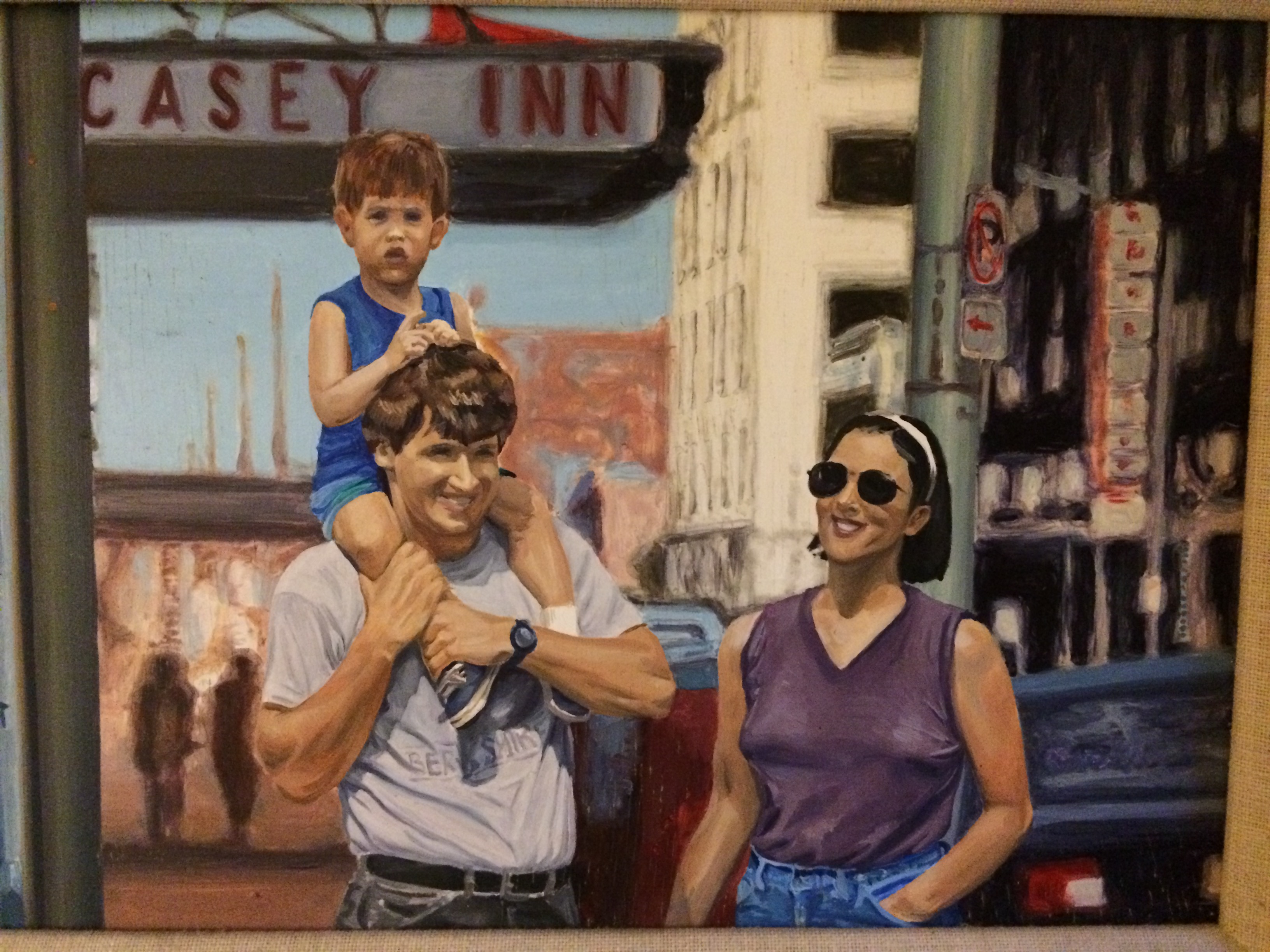
Painting by my sister, Patrice Needham.
My sister took a few pictures of us while we wandered around Scranton, whose early twentieth century architecture charmed us after the glass towers of Atlanta we were accustomed to seeing. She painted the picture from a photograph, and then gave it as a gift to my mother and father-in-law. Katherine’s maiden name was Casey, which is why we named our son Casey. Another connection is that Sean is wearing his Berkshires t-shirt (which I still use as a night shirt), the place where my in-laws lived every summer.
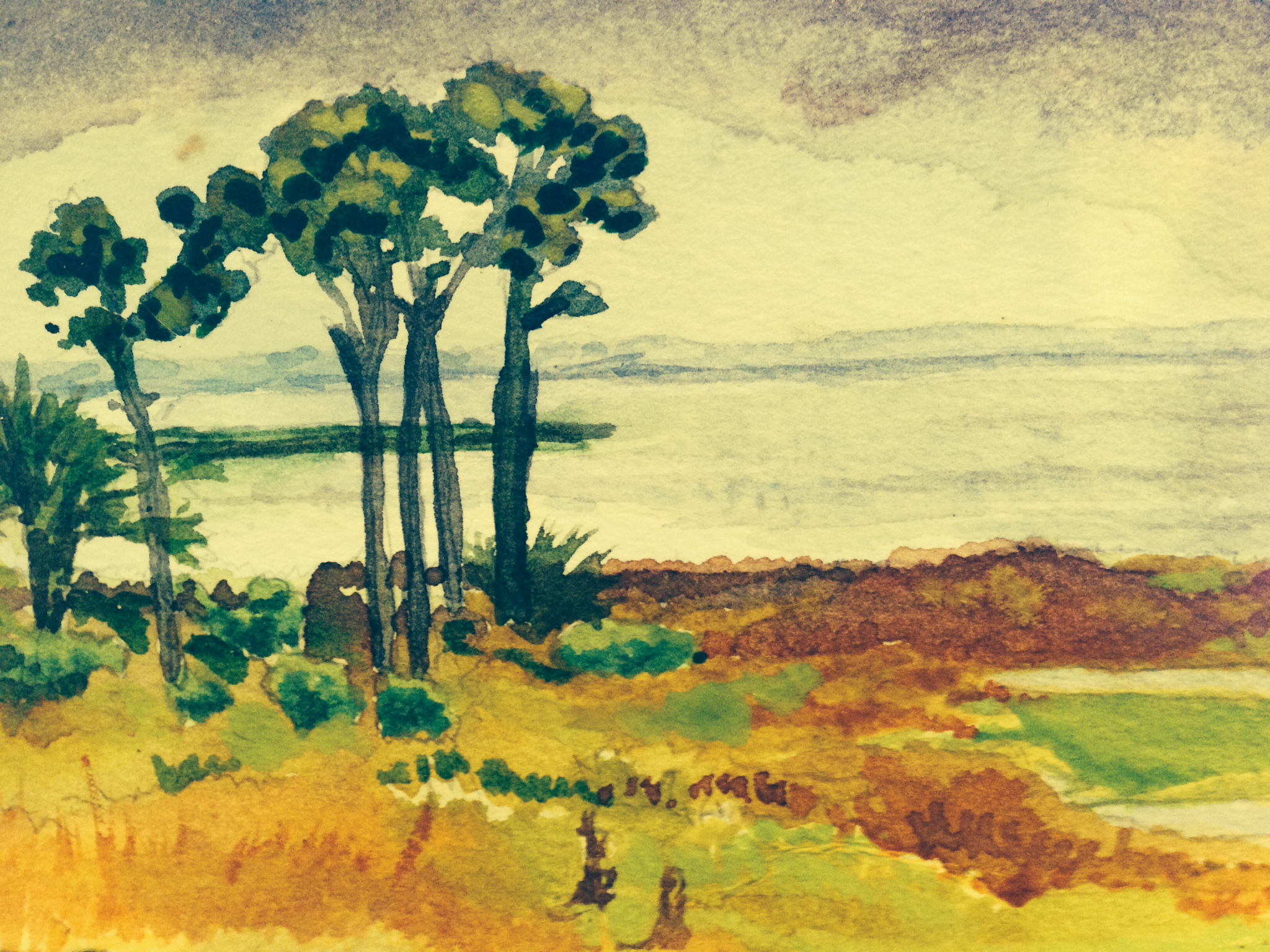
I rescued the painting from Katherine’s house since she’s planning on selling the place in the Berkshires. Now that she’s getting on in years, she can’t travel there by herself, much less live there alone for a summer. I like my sister’s photorealist style of painting. Her more recent work is plein air water colors, which I also find very beautiful. This one was painted at a beach trip we just took, on a postcard size water color block.
Plein air water color of Port Saint Joe Bay by Patrice Needham.
I’m sitting at the top of Monument Mountain, the place where Herman Melville met Nathanial Hawthorne for the first time.
It’s a hot day for the Berkshires. I’m sweating in the muggy air, but a slight breeze refreshes my skin. This humidity is nothing like the pizza oven heat of Georgia.
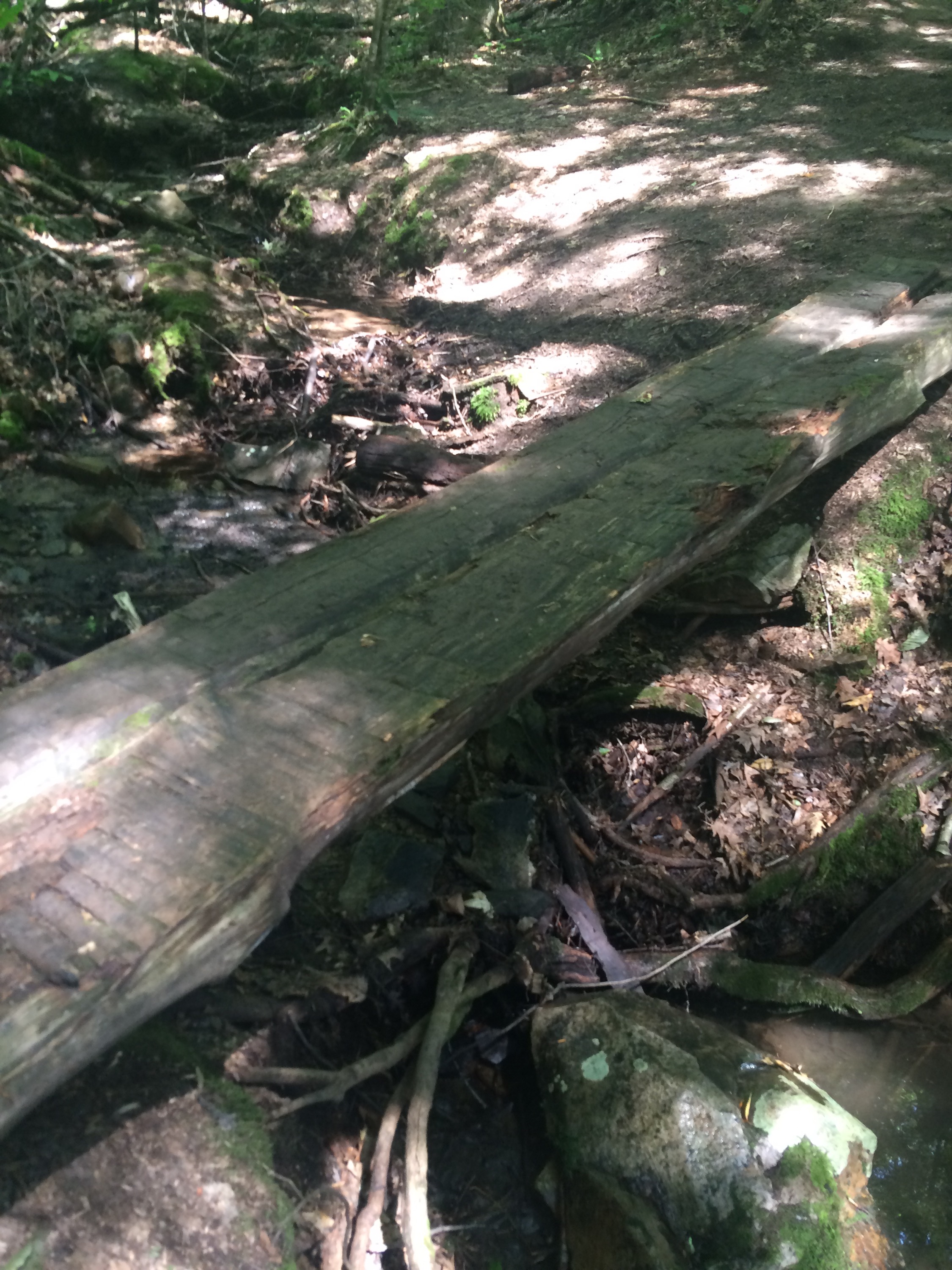
While going up the mountain I took a picture of a log bridge–I’m a little afraid of crossing narrow bridges, even when there’s nothing but a creek below. So I took a picture to illustrate the obstacles I’m forever confronting.
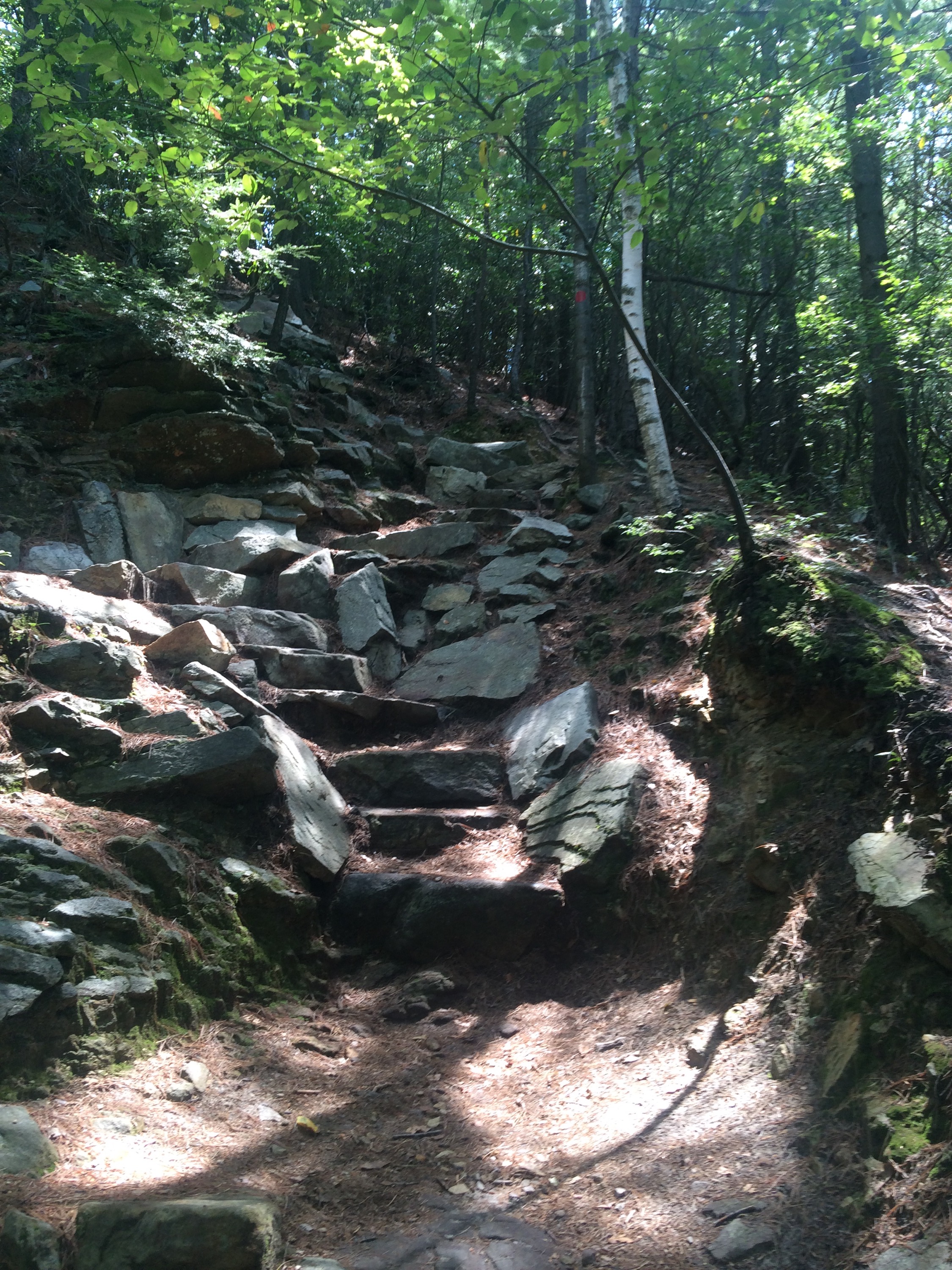
When I went to look for my phone to take another picture, this time of the rocky ascent to the summit, I realized I had left my phone at the log bridge.
So back down the mountain I went. A couple had seen my phone in the ground where it must have slipped out of my backpack (or what is more probable is that I missed the pocket completely, dropping the phone silently on the pine straw and moss covered path).
While climbing back up to where I am now, I thought I would maybe start leaving my smart phone behind when I go on these long walks. I usually put my phone in airplane mode, and I don’t check email, but I do use it to take pictures.
So here I am on the summit, thinking about Herman Melville and typing into a WordPress app. I read that the day he came here with a gathering of local literary types, it rained, and he spent a good while describing to Nathaniel Hawthorne the intricacies of manning a whaling ship.
The trail here is well maintained. The granite and schist stones form a staircase that allows the hiker to reach the top fairly easily, but I doubt the rocks were arranged so artfully when Melville walked here.
The air was the same, the flora and fauna the same, and some of the views. From where I am now, I can see Monument Mountain high school, where someone has written the name Maia in large white letters on the lawn in front of the school. Even from this height I can see the heart over the letter i in place of a dot. Someone loves Maia.
To enter the nineteenth century imagination, I think I would have to abandon iPhone technology for a while. I don’t even know how Melville would have traveled from his Arrowhead farm in Pittsfield to Monument Mountain in Great Barrington. Horse and wagon maybe? I know he liked to camp and was an avid outdoorsman.
He became depressed after Moby Dick didn’t sell, and he turned to alcohol. This is a lesson in not tying one’s ego to one’s art. I don’t blame Melville–he had to support his family, and he had wanted to do so by writing. Art and business don’t mix. Robert Graves said something to the effect : “There’s no money in poetry, and no poetry in money.”




 Balanced On the Edge