Tomorrow a double batch of banana muffins will bake themselves into existence. And then they will be devoured. And they will never know what they have been or where they have gone. Poor little muffins.

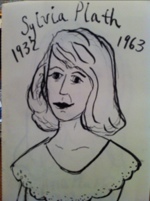
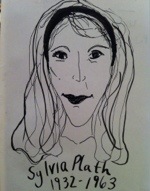
Halfway through Bitter Fame, a Life of Sylvia Plath by Anne Stevenson, I can say that although she does not paint as sympathetic a portrait of Plath as does Alexander in Rough Magic, she does get to the inner struggles Plath experienced that led to her poetic apotheosis in a more acute way.
Alexander had access to Sylvia’s mother while writing his biography, but he was writing blindly, because Ted Hughes did not allow him to view Sylvia’s letters or journals.
Hughes’s sister, Olwyn Hughes, worked with Stevenson and allowed her to quote extensively from Plath’s journals and letters.
Plath’s letters to her mother, as one might expect, give an optimistic report of Plath’s active social life and hard work at Smith and later at Cambridge, while her journal entries show she had an active, healthy sex life that unfortunately plagued her.
Part of Plath’s problem lay in her inability to reconcile her “swing from violent vampire to virtuous nun,” as Anne Stevenson writes (28).
The controversy around Plath’s life and death centers around her relationship with Ted Hughes. Obviously, she had an artistic temperament and was ambitious to the extreme. At the same time she was conformist and wanted to raise a family like her mother did.
Even though I was born three decades after Plath, I understand her ambivalence about motherhood, art, sexuality, and a career.
But her angst and passion led her to explore or flirt with death. She was too impatient to find out what lay beyond the moon at night.
Of course the shock of losing Hughes would have brought about a despair she couldn’t find a way to exit, but reading her Ariel poems, one realizes she was in the throes of a Dionysian fury that went beyond Hughes.
In the end, casting the blame for her death on Hughes means nothing. There are only the poems, which are as grand and sharp as polished steel.

I had the good fortune to attend both a reading and a workshop given by poet, musician, and writer Joy Harjo.
She came to the 41st annual Agnes Scott Writers Festival as a poetry judge, and she chose my work as the winning poem.
In the Agnes Scott theater, Harjo enchanted the audience with her poems, her children’s story, excerpts from her newly launched memoir, and Polynesian songs she sang and played on a ukelele.
Although the reading was joyous and celebratory, there was an undercurrent of mourning, because Joy Harjo had dedicated the night to her poet mentor and friend, Adrienne Rich.
The next day the poetry finalists met with Ms. Harjo to talk about our poems. She asked us to share what we thought were areas where we could strengthen our work, and she offered suggestions for revisions.
She admitted to the group that she was very much saddened by the passing of Adrienne Rich, and that the previous night’s dedication to her beloved mentor had taken a good deal of emotional energy.
She encouraged us to accept that death is real and that young poets should not succumb to the allure of suicide, as many poets and artists have done in decades past.
Of course, I am not a younger poet. I am a newly public writer who is not young. But some of the other finalists were in undergraduate writing programs, and a few of their poems were quite melancholy. It was good for all of us to hear Harjo’s wise words.
This doodle is the first in a series I’m starting titled “poets across the decades.” Just today I learned of Adah Menken from a friend who is writing her dissertation about this poet and actress.
Adah Menken’s poem “Infelix” can be read on the Poetry Foundation website.
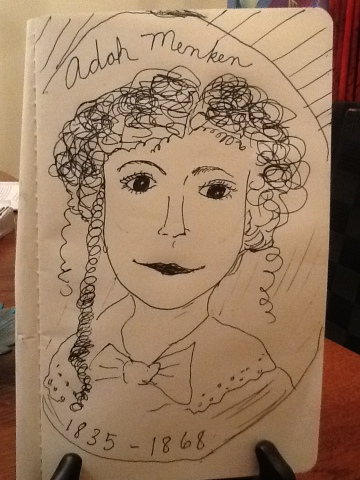
Although her life ended during her Jesus year, she wrote an autobiography and a collection of poems, acted on Broadway and in Europe, and married four times.
Since I’m working on an advanced degree in English, I figure it behooves me to re-visit British history; what better way to refresh my memory than watching period-piece dramas? Of course, not all historical fiction is made alike–Elizabeth, with Cate Blanchett, takes many liberties with the traditional narrative of the Virgin Queen’s early years, although the costumes dazzle and the acting mesmerizes.
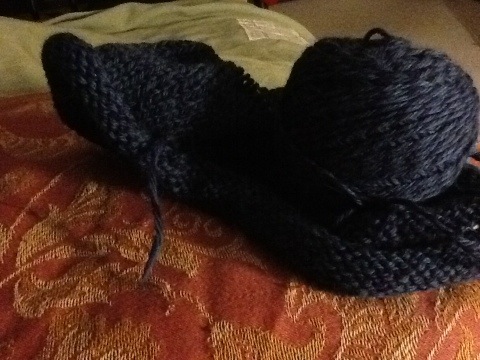
So now I’m streaming the classic Glenda Jackson Masterpiece series on Netflix. What joy! And I have the use of an iPad from the university I attend. By setting it up on a pillow, I can watch in bed and knit.
Happy, sad, happy, joy, content, bliss, blissful, happiness, peace, fulfillment, content, calm, floating, warm ocean, warm seas, dogs, cuddles, hugs, nice, niceness, hot coffee, sunny days, long walks, bright scarves, a painting, a drawing, a poem, sitting still, breathing quietly, enjoying the breath, colors, purple, red, yellow, green, indigo, plum, cyan, chestnut, roan, horses, palominos, Appaloosas, black stallions, a brindled mare, long manes, feathered tails, horses galloping across sand dunes at sunrise, Red’s mouth and gummy lips, Duffy’s domed forehead, talking to Jacob about philosophy, talking to Aiden about art, listening to S. talk about politics, playing solitaire, writing in my journal, reading memoirs, reading biographies of other writers, visiting writers’ homes, finding legends that pique my imagination, getting lost in a good book, remembering the beach in Mexico.
My three mantras for 2012 are to listen more closely, pay attention, and be happy. The last one means, among various shades of emotion, to achieve equilibrium, inner peace, and calmness.
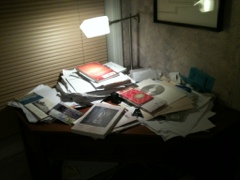
Therefore, I need to clean off my desk. I need to clear a space for writing. As a Libra, I thrive in a harmonious environment. I will recycle all unnecessary papers and shelve the books and folders from last semester. Time to let the new mess begin.
Text from my journal:

Nightingale Woman
Birds fly into my face,
birds on my chest beating their wings,
birds trying to escape
my ribcage, from
beneath my dress.
I used a hacksaw with my right hand to cut off a piece of plastic from my car. This feat was all the more risky because I am left handed. Halfway through the procedure I realized I wasn’t wearing my glasses!
Said plastic seems to have served no crucial purpose. It had been dragging underneath the car, and so I had duct taped it to the bumper, but duct tape needs to be applied copiously in order to withstand wind, rain, and gravity, so the plastic once again had begun to scrape the road.
I’ve driven to the city without the part and all is well. I even managed to arrive on time for a presentation by Andrea Lunsford. She spoke about rhetoric and new media literacy.

The sign above is from November 5–the mayor of Atlanta had already shut down the Occupy camp when this sign was put up. I found it on the inside of a bathroom stall at the university where I’m a TA. There was a whole debate going on in scribbled writing about the American Dream and how it’s dead.
Two weeks have passed since streams of police cars, helicopters, and ground troops shut down Occupy ATL.
Since then, protests at Berkley and Davis have produced vile reactions from authorities. Even though the Davis chancellor has so far declined to resign, and though she has apologized, she needs to take stronger responsibility for how the police pepper sprayed the students.
UC Davis Chancellor Apologizes
Freeboarder has been at art school for a month, and already he’s questioning the need for an academy to teach him how to make something.
I’m proud of him for asking the questions. The same debate occurs in the world of poetry, with many wondering if there is a need for the now ubiquitous M.F.A. in creative writing.
One talented student told Freeboarder that “art is dead.” My answer to that statement is that art simply is. The student was probably trying to sound provocative and oracular. Maybe he wanted to psyche out his competition.
Going to art school allows the artist a chance to live within a community of skilled, committed people. Of course, we can create those communities ourselves, outside the Academy.
Atlanta has a thriving arts community that originates with the people. We have wall art, street sculptures, and spoken word events, all outside the ivory tower.
Freeboarder got a little shaken from the statement that art is dead. I told him that if art is dead, human culture is dead, because the act of making is an inborn, human right.

 Balanced On the Edge