Writing after practicing yoga and meditation is one of the best ways to release creativity. With a relaxed body and mind, we can touch our inner feelings. Writing with a group where we feel safe and nourished, we can take small risks with our writing and reveal heartfelt truths.
For the past six months or so, a group of us have been meeting once a month after our wonderful yoga teacher’s Saturday class to generate new writing. I’ve been leading the writing circle because of my certification with Amherst Writers and Artists, a writing circle method devised by Pat Schneider.
Fill your bowl to the brim
and it will spill.
Keep sharpening the knife
and it will blunt.
Chase after money and security
and your heart will never unclench.
Care about people’s approval
and you will be their prisoner.
Do your work, then step back.
The only path to serenity.
I wrote these lines based on the prompt:
Overflow
My heart is a bowl
that, today at least,
brims with anger.
Rage spills over the rim,
pulses into my chest, my throat.
But rather than opening my mouth,
I take to the street
and walk with my anger.
Inhaling the fresh fall air,
I release my bitterness.
The last yellow and orange leaves
hanging on the lowest branches
of a cottonwood tree
glitter in the breeze
like Tibetan prayer flags.
Yesterday I woke at 7:00 and, once again, stayed in bed until the anxiety passed. I meditated for twenty minutes, focusing on the breath and relaxation.
I let the dogs out and made coffee. Coffee works its magic by returning my optimism to me, especially if I make it half decaffeinated. A little goes a long way.
But the sink full of last night’s dirty dishes soured my mood. I had asked for help, but the men in my family see no problem with leaving the countertops dirty for a day or two. Since I’m the one with the problem, I end up cleaning, and I’m left with resentment.
On top of the dirty dishes, I had to forgo working on my Camino travelogue so that I could drive my father to the hospital. He has a staph infection in one of his heart valves, but he refuses any more surgery.
His only other option is to go to the hospital every day for six weeks to receive an infusion of antibiotics that go directly to his heart. His insurance won’t pay for in-home care because he is “ambulatory,” but he’s too weak to drive. My siblings and I are sharing the daily driving with my father’s wife (my parents divorced years ago) so that she doesn’t have to do it all.
When my son Freeboarder saw my glum mood, he tried to lift my spirits. “I know you don’t want to sacrifice your day of work,” he said, “but think of the good karma you’re generating.”
I know Freeboarder’s right. I know I have to help my father, in spite of our fraught relationship over the years. I have to help him because he is a part of me, because he is at the end of his life, and because underneath his stoicism he couldn’t help but be afraid. This is one of those moments in life when to help might create momentary resentment that in the long run contributes to overall happiness.
So I brought Dad homemade tomato and roasted red pepper soup and made him a few grilled cheese sandwiches.
On the way into the center, while I was parking the car, Dad almost fell. He walks with a cane and has arthritis in his spine and neck, so he might have stumbled, or he might have felt faint from weakness. But a male nurse happened to be walking right next to him as Dad started to go down, and the nurse caught him.
After Dad and I left the cancer center where he’s receiving his treatments, the sun was still bluing the sky at 4:30, however faintly. We were both still alive. We marveled at the miracle of the nurse who caught his fall, a guardian angel who appeared at the right moment to spare Dad more pain.
I’ve been spending more time reading than writing lately, so in an effort to keep up my presence on this blog, I thought I’d share some of the books I’ve either listened to or actually read this past month. Almost all of them are self-help books related to Buddhism. I find it very relaxing to listen to audiobooks before falling asleep at night. I set the timer for an hour and listen until the words fade out of my consciousness.
Body and Mind Are One, a training in mindfulness, by Thich Naht Hanh. This book consists of a series of dharma talks Thich Naht Hanh has given at Plum Village, the monastery he founded in France. Thay, or teacher, as his students affectionately call him, has a gentle way of teaching mindfulness. He goes into detail about creating a sangha (community) where practitioners can communicate their hurts or delights with each other in a compassionate manner. I’d love to be a part of a sangha in the town where I live, but I don’t want to take the initiative to start one, at least not now when I’m in the middle of writing a travelogue of my pilgrimage. So I put Thay’s teachings into practice with my family and friends.
Bringing Home the Dharma by Jack Kornfield. Kornfield discusses his life experiences with Buddhist meditation, beginning with his life as a student of Asian studies at Dartmouth College and continuing as a novice monk in Thailand. He later explores the evolution of the dharma as it has manifested in the U.S., and includes a chapter about problems with sexual misconduct and abuse of power that has occurred in “almost all” Buddhist meditation centers in the U.S. I appreciate his honesty and his willingness to face the problems. Kornfield acknowledges the need to hold frank discussions about sex, alcohol abuse, hallucinogens, and anti-depressants and how they relate to practicing mindfulness mediation in the 21st century.
Rising Strong by Brené Brown. I first became aware of sociologist Brené Brown after listening to her interview with Krista Tippet on On Being, when she spoke about vulnerability and shame. Shame is such a strong force in our culture, and we are so willing to bend to its power. Who hasn’t made mistakes in her life? Who hasn’t wanted to cover her tracks when her cover is blown? In Rising Strong, Brene Brown bases much of her writing on a quote by Theodore Roosevelt that she has taken into her heart:
It is not the critic who counts; not the man who points out how the strong man stumbles, or where the doer of deeds could have done them better. The credit belongs to the man who is actually in the arena, whose face is marred by dust and sweat and blood; who strives valiantly; who errs, who comes short again and again, because there is no effort without error and shortcoming; but who does actually strive to do the deeds; who knows great enthusiasms, the great devotions; who spends himself in a worthy cause; who at the best knows in the end the triumph of high achievement, and who at the worst, if he fails, at least fails while daring greatly.
Rising Strong teaches the reader to not make negative assumptions about another person’s reactions to us. Rather than judging others for what we perceive as negative qualities, she encourages the reader to instead assume that others are doing the best they can in a given situation.
Brown is very open and honest about her own failures, using them to illustrate how, when we find ourselves planted face down in the arena, we can find the courage to rise up. Brown’s book offers the reader a path toward learning from failure rather than retreating in shame or discouragement.
Behind the Beautiful Forevers by Katherine Boo. I found this book on a forum for women travel writers, where it was suggested as an alternative to Elizabeth Gilbert’s Eat, Pray, Love. The discussion centered around an article titled “How Not to Be Elizabeth Gilbert,” and Boo’s work was offered as an alternative to Gilbert’s writing. Although I found the article about Gilbert to be mean spirited ( women writers don’t need to shame other women writers in order for their own voices to be heard and appreciated), I still appreciate learning about Katherine Boo’s writing from the discussion.
Boo’s book is journalistic exploration of the slums located near the airport in Mumbai. I don’t consider books such as Eat, Pray, Love or Cheryl Strayed’s Wild to be travel writing. They are memoirs whose stories are revealed while the women embark on a journey. Even though the book I’m writing has more in common with Gilbert and Strayed’s concept of a travelogue/memoir, I was thoroughly impressed by Boo’s ability to get inside the minds of the children in the Annawadi slum.
The Art of Memoir by Mary Karr. I’ve been a fan of Mary Karr’s memoirs ever since reading Liars Club. What makes her writing unique is her ability to recreate the voice of her child self while at the same time punching up her prose to meet the expectations of a literary reader. In the Art of Memoir, Karr advises the reader to develop her own voice, relating that she herself spent at least a year writing her story before she found the way to channel her East Texas vernacular. She also advises the emerging memoirist to immerse the writing in carnality, in other words, to engage the five senses and put the reader in a scene, fairly basic writing tenets. What I most liked about the book was Karr’s discussion of memoirs she teaches as well as the list of recommended memoirs she includes at the end of the book.
This past weekend S.A. and I drove to Florida to pack up his mother’s belongings and ship them to the assisted living apartment she moved to in Chicago.
She told us she wanted all of her clothes, but after stuffing a garment bag and five suitcases with all the items we could manage, many racks of evening gowns, dresses, skirts, blouses, wraps, bags, and shoes remained, so we made the decision to give her lifetime collection of finery to charity.
I hoisted her beautifully arranged outfits into industrial-sized garbage bags and with the help of one of my MIL’s neighbors, drove them to a local thrift store that services the homeless and veterans. Other bags went to Goodwill, and others to Salvation Army.
I felt sad to see my MIL’s artfully selected skirts and blouses crammed into bags. Why didn’t she give some of this clothing away over the years? Now that she’s older, she stays in her muumuu most of the day, and when she goes to the grocery she puts on the same sweater and frayed pants.
On the Camino, I had to pare down my belongings because of the weight. To keep my pack under 15 pounds, I had only one pair of spare shoes in addition to my boots, four shirts (two too many by the standards of micro-lightweight packers), one pair of thermal Smartwool leggings to wear as pajamas and as pants for the evening, three pairs of underwear, two sports bras, and four pairs of socks.
I will admit that when I walked around the streets of Pamplona, Burgos, and Leon in the evenings, cities that the Camino passes through, I felt somewhat oafish compared to the neatly dressed Spanish women out on the streets with their beaus or their families. But walking the Camino is a lesson in humility if nothing else. I had to let go of my vanity if I was going to make the distance to Santiago.
One of my Camino friends, Carolina, a lovely blonde from Brazil, said that when she arrived in Santiago she would treat herself to a dress and some make up as a way to celebrate and restore her sense of beauty.
I ended up finding a nice summer dress on one of the main streets of the historic part of town in Santiago, and it has become my main dress. I took it to the beach and to the mountains, I’ve worn it to almost every poetry reading I’ve attended this summer in Atlanta, and I might even bring it on my next pilgrimage–it’s lightweight, dries quickly, and can be worn over my thermal leggings.
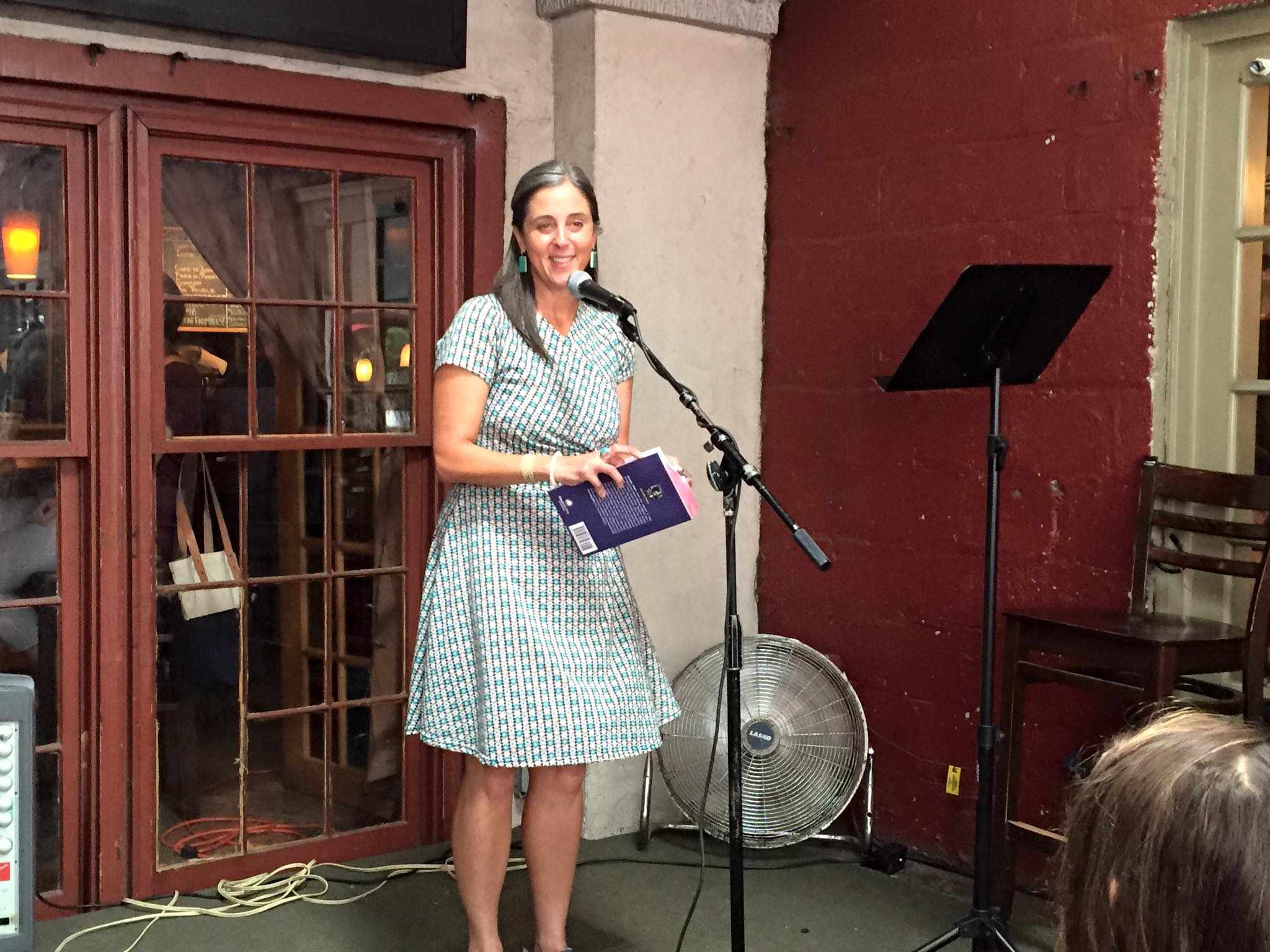
Decatur Book Festival, photo by Lisa N. Allender. I’m wearing my Camino dress bought in Santiago at the end of my pilgrimage.
Before emptying out my MIL’s condo I had already begun the process of paring down my own belongings. I’ve had to face my proclivity to hoard books. I have them piled up next to my bed, stacked on shelves in every room, and even stored in boxes in the garage. I’ve donated many of them to Goodwill and other organizations, and I will bring others to the library.
But giving away or selling possessions is only a physical manifestation of other more important aspects of my life that I need to give away. Just as I let go of my vanity on the Camino, at least for the most part, now I’m working on letting go of fear and anxiety.
If I feel a vague twinge of negative energy, my tendency is to tell myself a story that gives me a concrete reason to worry. So these stories are what I’m going to let go. I’m letting go of fear. First I will give fear a gentle squeeze on the shoulder, then I will pat it on the back and wish it a safe journey. Goodbye, old friend, buen viaje.
In Parker Palmer’s column at On Being, he writes about allowing his life’s unfolding to be guided by open-ended questions that look at the big picture.
Here is an example question he gives at the end of the post, which he arrives at after some give and take with the wording: “What do I want to let go of, and what do I want to give myself to?”
Questioning the universe and then listening for its wisdom seems like a gentle and good way to live a life. In yoga there is a similar practice of sankalpa, translated as an intention, a resolve, or awish.
When I practice yoga nidra, a 45-minute relaxation meditation, at the beginning of the session I allow a sankalpa to manifest itself in my mind. Sometimes I have a clear image of myself realizing my wish. When I was preparing for my pilgrimage to Santiago de Compostela, I would see myself walking on an open road under a blue, blue sky, experiencing total freedom. And ultimately, at moments, this freedom is what I experienced.
When my son returned from India, he told me he learned that a yogi makes plans, sets an intention, and then lets the intention recede from his conscious mind. In other words, he doesn’t fret over the outcome. All his actions will lead toward the manifestation of his wishes.
I like the practice of posing a question and waiting for the stream of life to unfold. By allowing a question to guide us, our very lives become the answer.
My question is this: How can I feel more at peace in my heart and mind, and how can I share this peace of mind with others so that they too can experience peace?
In a way, the question is a mission statement for a life, but since it’s open ended, it doesn’t presuppose that we already know how to achieve the outcome or even what that outcome will look or feel like.
When I came home from Spain on June 30, I was not anxious at all, even after discontinuing all the medications I had been taking. Now, two and a half months later, some of the old anxieties are creeping back, and even though I continue walking, meditating, and reading inspiring books, it’s rare that I don’t feel the pain of some ancient grief bubbling up.
The difference now, after the Camino (A.C.!) , is that I don’t take any pills to muffle the gnawing, nibbling discomfort. As I learned from the gentle teachings of Thich Nhat Hanh, I say to the anxiety, “Oh, hello old friend. What do you have to tell me today?”
My old friend anxiety says: Keep walking. Keep writing. Breathe deeply and slowly. Listen deeply. Be patient.
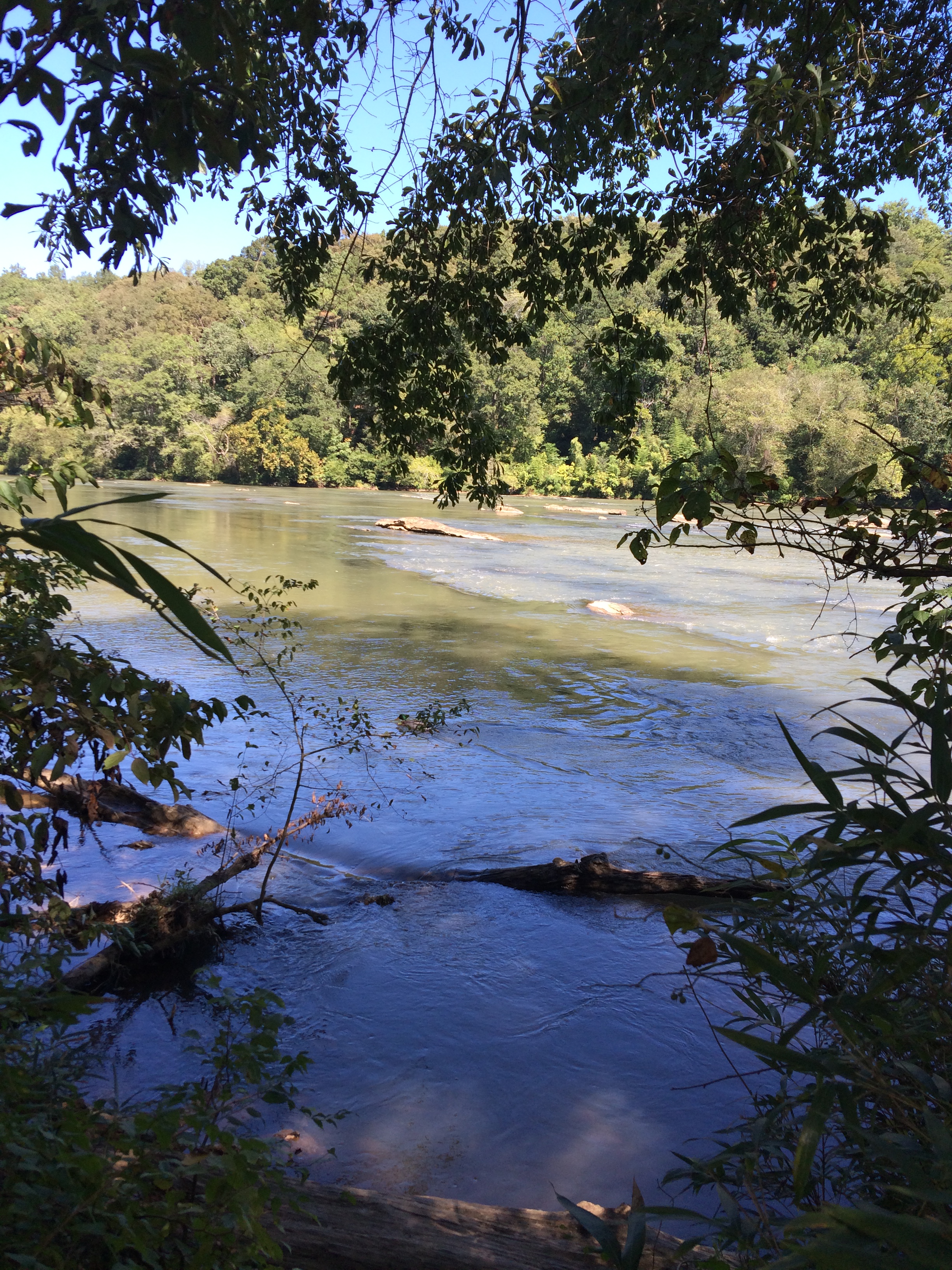
Chattahoochee River, Late Summer
*** If you take medications, please don’t stop taking them because of what you read here. I’m not a professional therapist of any kind, and I only speak of my own experience. I have taken different anti-depressants for decades, and I think they might have helped me at one point or another. They certainly seemed to help. But I have the support of a therapist, my family, and many years of life to help me face my inner demons, and I believe I am ready to do this one day at a time, breath by breath.
My true home is life itself. My true home is the here and the now.
–Thich Nhat Hanh
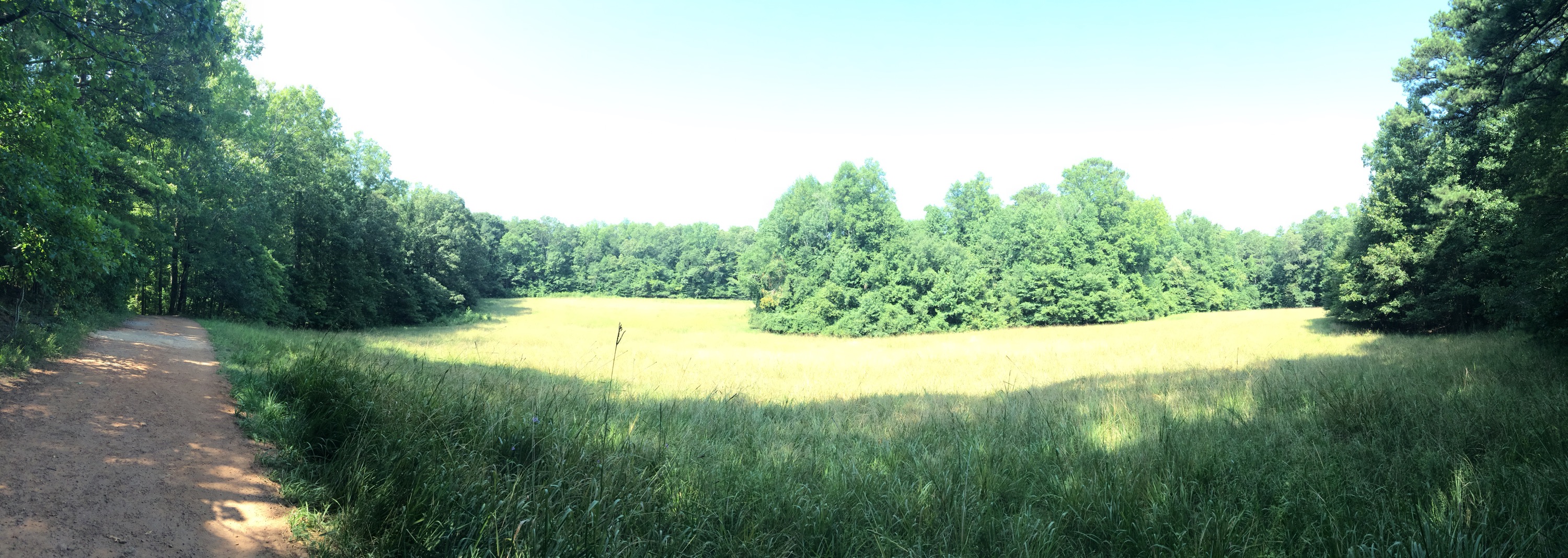
Kennesaw, Spring 2015
Filed under the label stuff I tell myself is the adage that we shouldn’t postpone our happiness.
When I came home from the Camino, my heart was cracked wide open from the effort of walking by myself from the Pyrenees in France to Santiago de Compostela in Spain.
A woman whose heart has cracked open looks like this: she cries over the littlest things, or she experiences sympathetic joy (not the typical jealousy or envy she used to feel); she’s in tender mode; she’s patient with those who still don’t know they are on a pilgrimage.
Because we are all on a pilgrimage, whether we know it or not.
Lately, though, I had been postponing my happiness and slowly I felt my heart begin to harden. I had been caring for my mother-in-law for a month and a half, and walking had become an escape from the fact of her constant presence in the house. Rather than walking to reconnect with myself, I was walking to escape. I was postponing my peace of mind until the day she would go to Chicago.
I found myself already planning my next pilgrimage to France without having fully processed and integrated my recent journey to Spain. An escape maybe?
But I have found comfort and redirection in the words of one of our time’s greatest sages, Thich Nhat Hanh, a world-renowned Vietnamese Zen Buddhist monk who has helped refugees and war victims recover from their trauma through mindfulness meditation.
In his audiobook titled Living Without Stress or Fear, Thich Nhat Hanh explains how mindful walking can reconnect us with the present moment, the only moment where life takes place. He suggests while walking to breathe in and think “I have arrived,” and on the exhale to think “I am home.”
Mindful walking does not have any outward destination in mind, but rather it is inward. When we reconnect with the simple act of breathing and walking, we rediscover happiness in the present moment. That’s how it works for me, and it works for others, too.
And so I felt much gratitude for having the freedom to step out of my house and walk, with my only goal to connect with the ease of my breath, the ease of being. Walking is not an act that we can take for granted. Connecting to the joy of being alive is what I am grateful for today.
I’m sitting at the top of Monument Mountain, the place where Herman Melville met Nathanial Hawthorne for the first time.
It’s a hot day for the Berkshires. I’m sweating in the muggy air, but a slight breeze refreshes my skin. This humidity is nothing like the pizza oven heat of Georgia.
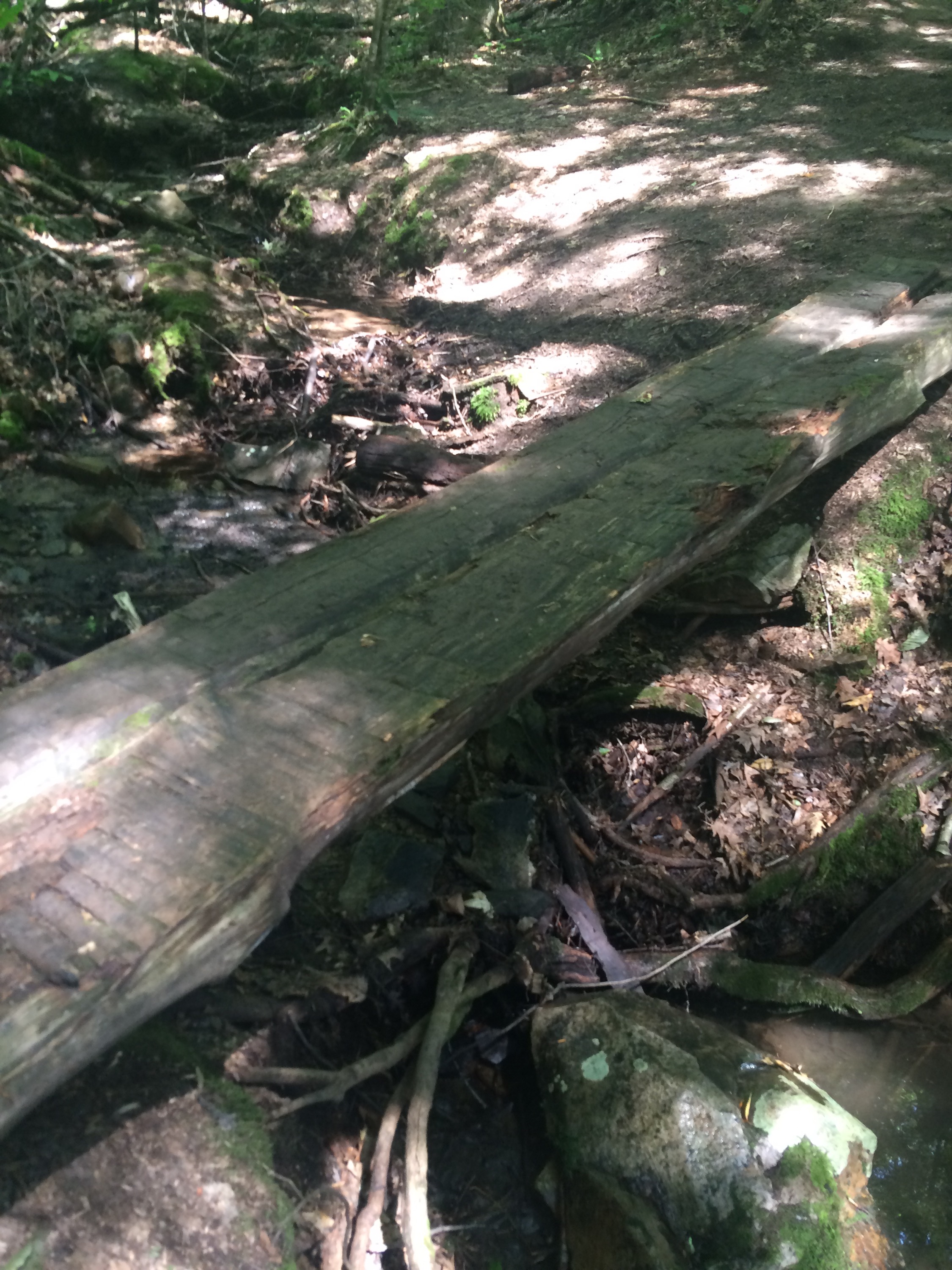
While going up the mountain I took a picture of a log bridge–I’m a little afraid of crossing narrow bridges, even when there’s nothing but a creek below. So I took a picture to illustrate the obstacles I’m forever confronting.
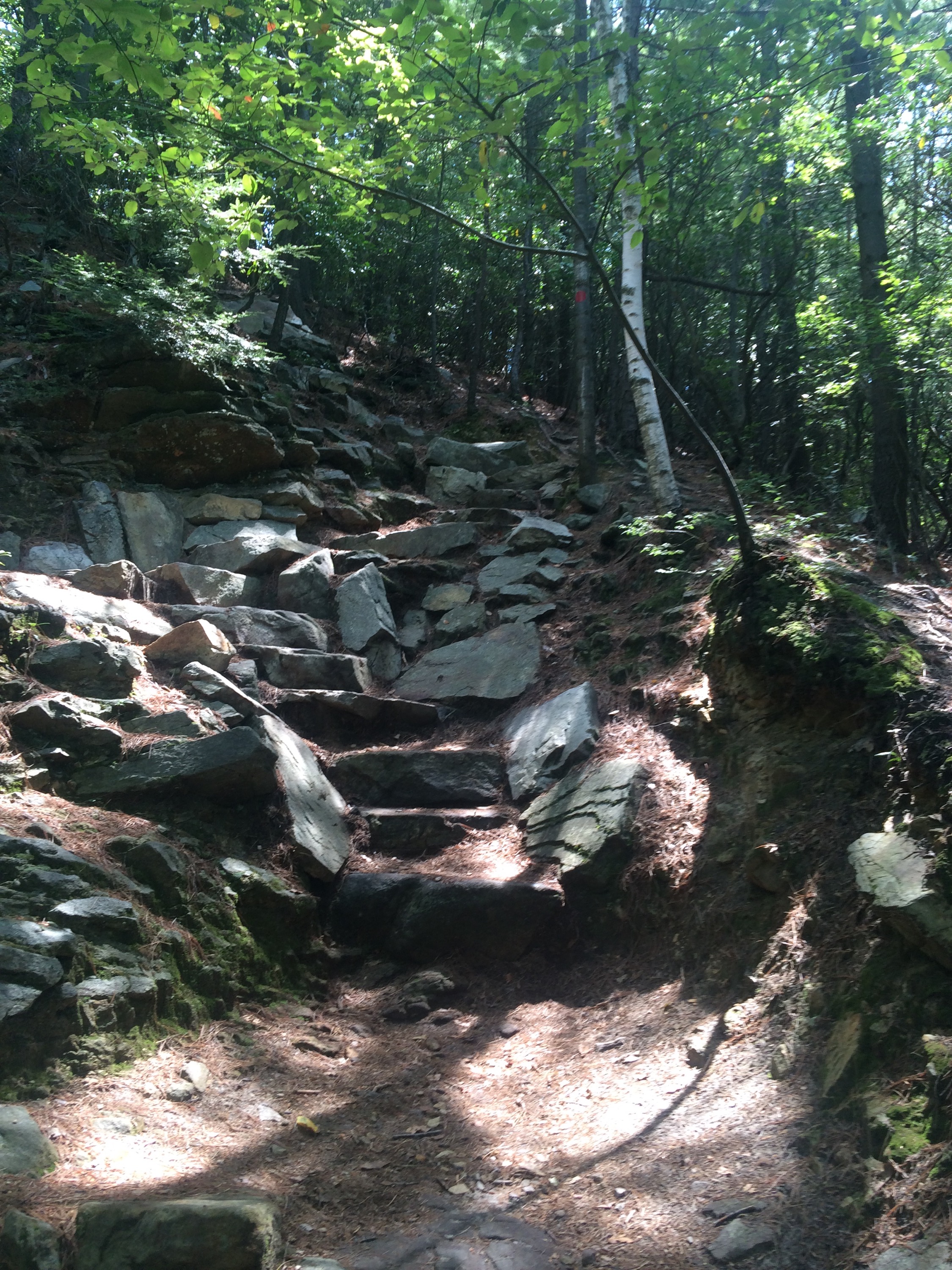
When I went to look for my phone to take another picture, this time of the rocky ascent to the summit, I realized I had left my phone at the log bridge.
So back down the mountain I went. A couple had seen my phone in the ground where it must have slipped out of my backpack (or what is more probable is that I missed the pocket completely, dropping the phone silently on the pine straw and moss covered path).
While climbing back up to where I am now, I thought I would maybe start leaving my smart phone behind when I go on these long walks. I usually put my phone in airplane mode, and I don’t check email, but I do use it to take pictures.
So here I am on the summit, thinking about Herman Melville and typing into a WordPress app. I read that the day he came here with a gathering of local literary types, it rained, and he spent a good while describing to Nathaniel Hawthorne the intricacies of manning a whaling ship.
The trail here is well maintained. The granite and schist stones form a staircase that allows the hiker to reach the top fairly easily, but I doubt the rocks were arranged so artfully when Melville walked here.
The air was the same, the flora and fauna the same, and some of the views. From where I am now, I can see Monument Mountain high school, where someone has written the name Maia in large white letters on the lawn in front of the school. Even from this height I can see the heart over the letter i in place of a dot. Someone loves Maia.
To enter the nineteenth century imagination, I think I would have to abandon iPhone technology for a while. I don’t even know how Melville would have traveled from his Arrowhead farm in Pittsfield to Monument Mountain in Great Barrington. Horse and wagon maybe? I know he liked to camp and was an avid outdoorsman.
He became depressed after Moby Dick didn’t sell, and he turned to alcohol. This is a lesson in not tying one’s ego to one’s art. I don’t blame Melville–he had to support his family, and he had wanted to do so by writing. Art and business don’t mix. Robert Graves said something to the effect : “There’s no money in poetry, and no poetry in money.”
S.A. and I are still in the Berkshires, but our sons, who drove up for the week with the dogs, have now left for home.
We’re staying a week longer with Katherine to help her with her house and her decision to sell it. Since she’s in her eighties and does not use the Internet, she needs our assistance. The world has evolved from looking for real estate agents in the phone book, alas.
After our sons left, I felt so alone. I went for a walk up Cone Hill Rd, but after an hour in the sun and fresh air, some of the sadness drifted off and sailed into the approaching clouds.
On the Camino people were constantly entering and leaving my life. Even though it wasn’t the same as missing my dear sons, I still felt the joy of seeing old friends and the pang of sadness at our leave taking.
Each day on the pilgrimage had a different tenor, and after a while I learned to accept whatever the day brought.
After reaching Sarria, where many routes converge and the number of pilgrims increases, I listened to the wisdom of a longtime pilgrim who said, “After Sarria, the Camino changes. It becomes a giant picnic where people are out for a good time. You have to adjust.”
Instead of feeling irritated at the maurading teens on the path with their iPhones piping in pop music, I opened myself up to a new experience without judging myself or others. I didn’t love the blaring music and the screaming laughter after my weeks of meditative solitude, but I enjoyed the kids’ enthusiasm for life and their excitement of being with school friends on the Camino. I accepted the new day.
So now my sons are gone and it’s just S.A., my mother-in-law, and I in her little house near the creek with no Internet or TV. It’s a new phase of my time here without my sons’ lively conversation and zest for life. I’m adjusting to the quiet by walking, writing, and swimming across the Stockbridge Bowl. If it rains tomorrow, I’ll go to a yoga class.
And it goes without saying that I need to cultivate gratitude for being in such a beautiful place during summer vacation time.
On a physical level, the best outcome of my pilgrimage is that after 22 years I have been able to go off anti-depressants.
I don’t mean to judge anyone who takes SSRIs, not at all. We are all trying to figure out what our lives mean and how best to live.
It wasn’t the Camino alone that helped me ween myself off them. I also had the help of a mind-body therapist who continues to offer suggestions for passing through anxiety and panic, the two main symptoms of the depression I have experienced off and on since childhood.
If the medications work, then take them. But after more than two decades on various SSRIs, I had fluctuating blood pressure and strange head rushes that led to near fainting, symptoms that have now disappeared since I went off the medication.
I attribute my peace of mind to the days and days of spending six to eight hours outdoors, walking and meditating. Even though the heat in Georgia can be unbearable, I continue to walk.
Each day is a new challenge in maintaining a balance of body, mind, and spirit. I’m tottering on a fragile tightrope of sanity, but walking and writing continue to be my medicine.
Yesterday’s hike:
About 8 or 9 miles, from Burnt Hickory Road to Dallas Highway at Kennesaw Battlefield Park, then on to the visitor’s center and back to Burnt Hickory.
Creatures I noticed:
Dragonflies, ants, butterflies, various birds, including two giant vultures, a wee toad, about the size of my thumb pad, a chipmunk, many squirrels.
I stood still and listened to the cicadas in the trees and the grasshoppers in the tall grass. There was very little breeze, and the trees were still and silent, their leaves dry and weary from the heat. The noise from the highway and the passing trains at times overpowered the silence of the woods.
It was a heavy, humid trek. I encouraged myself to keep walking by remembering the way I felt toward the end of my walks on the Camino–with sore feet and tired legs, I still managed to make it up those steep inclines. You can do this, I told myself.
Yesterday S. and I took our inflatable paddle boards out on the Chattahoochee River above the dam. We started at the Nature Center and paddled to Morgan Falls park, where the dam is. We paddled about three miles there and back.
Because of the dam, there is very little current, a good place for S. to learn the basics of paddling. He fell in once, but only because he wanted to see if he could go faster by standing farther back on the board. Laura, the woman who taught me the fundamentals of SUP and SUP yoga, said to always stand on the “sweet spot,” the very center of the board where the handle is.
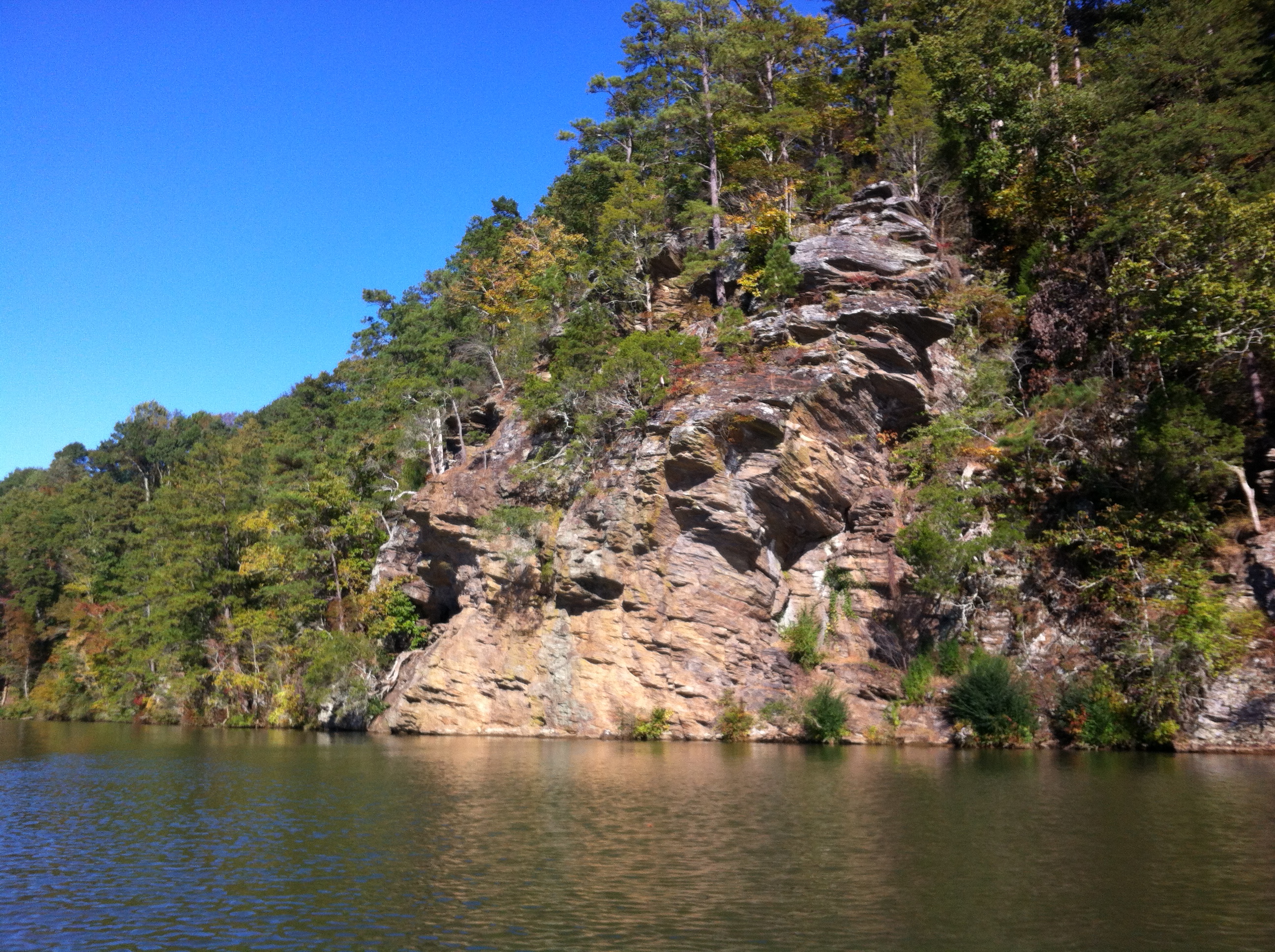
The July sun cast a withering heat over the afternoon sky. Storm clouds gathered here and there. Pines and oaks greened the banks in a hazy blur. Water rippled like melting glass and shimmered on outcroppings of sandstone cliffs that jutted over the river.
We paddled in silence, greeting fellow boaters as we passed them: a mother kayaking with her son, who wouldn’t hear of him jumping off the cliffs with the older boys; a young couple who had been floating downstream in an inner tube for five hours; a young man who was practicing headstands on his board.
Paddling on a lake feels a lot like walking. Time slows down. Once I got the hang of balancing on the board, I could pay attention to the horizon, the ducks swimming nearby, the blue heron soaring toward a nest high up in a pine tree.
Maybe it’s because I’m entering old age, or maybe it’s because of experience, maybe both, but I am learning to slow down with everything I do. By slowing down I accomplish more, paradoxically. When I ease up my pace, my heart softens. With a malleable heart I open myself to the world. I become porous.
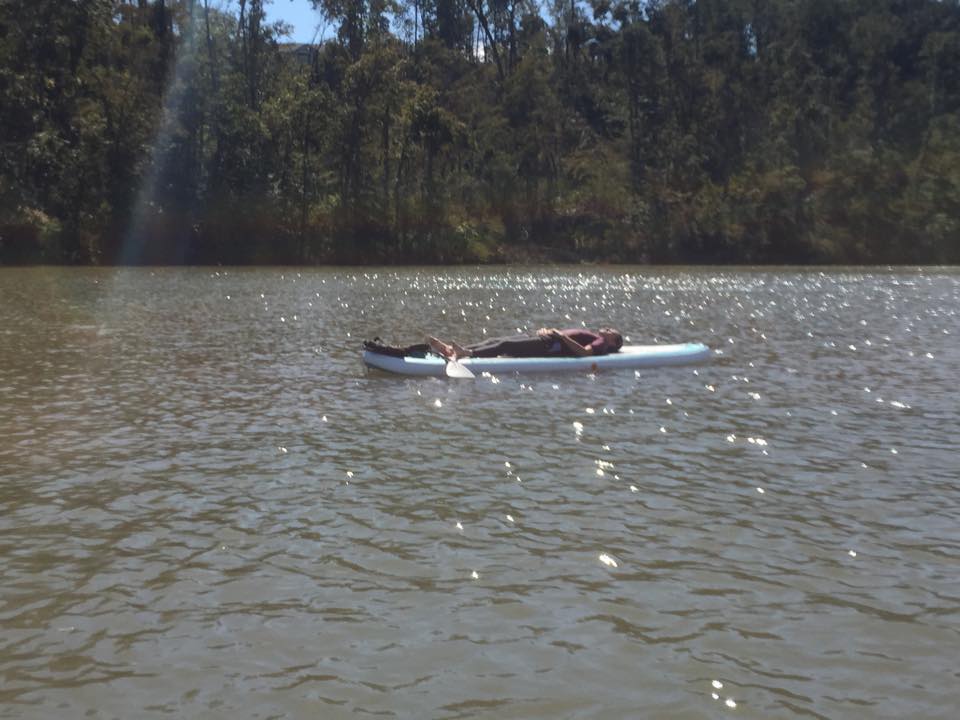
Photo by Christine Swint. Cliffs near Morgan Falls dam, October 25, 2014.Photo by Laura C. Mirando, SUP yoga class above the dam near Morgan Falls, October 18, 2014.



 Balanced On the Edge