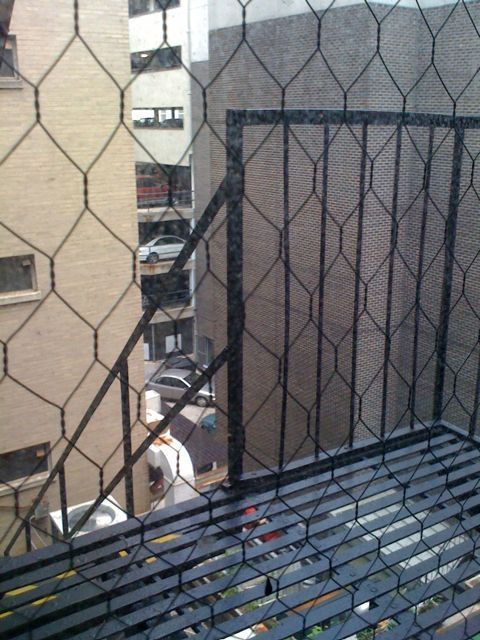
My office looks out onto rat’s alley. Yes, I’m alluding to The Waste Land, but there really are rats down there. They must like the vat of discarded fast-food grease next to the parking deck.
But there’s a view, with natural light. And the air conditioning works. A huge improvement on last year’s basement office.
I visited the Dalí exhibit again, this time with a poet friend who hosts the radio show melodically challenged on WRAS. Her program broadcasts on Sundays from 2:00-4:00 in the afternoon, and features poets reading their own works, along with music that enhances the show’s theme. One of the more recent playlists highlighted poems about birds, or poems that include birds. I intend to tune in this Sunday.
It was fun to walk through the exhibit a second time. At my friend’s suggestion, we used the audio tour as we progressed through the halls, and we ended up finding out a lot that would have gone unnoticed had we merely meandered along on our own. One interesting aspect the curators brought out was how Dalí experimented with how he applied his medium to the surface–he used a loaf of bread, his mustache, a rhinoceros horn (which he equated with the unicorn, a symbol of virginity), and an octopus. He also shot paint pellets out of a gun, a technique he dubbed “bulletism.”
I also found out why he was kicked out of the Surrealist movement: with Marcel Duchamp’s blessing he included a painting with religious iconography in a Surrealist exhibit, a theme the surrealists rejected. So he was ousted. The title of this exhibit is Dalí, The Later Works, a time period that until recently has not been admired by art critics, maybe because of the religious nature of the pieces. I did read, however, that Dalí declared himself a “Catholic without faith,” and that he did not believe in miracles.
I’ve already written two drafts of poems in response to his paintings. This summer has been very contemplative for me. I’ve been reading After by Jane Hirschfield and studying Buddhism, meditation, yoga. All the mind work, plus lap swimming, to calm my inner waters.
Even though I want to be at peace, I’m very drawn to the zany world of Da Da, Surrealism, and dreams. I keep thinking that if I remember my dreams and explore the images the meaning of everything will fall into place. A pretty illusion.
Emily Elizabeth Schulten read from her collection Rest in Black Haw (2009, Summerfield Press) for the Solar Anus Reading Series at Beep Beep Gallery in Atlanta. Many of the poems from her book, rich with imagery of domestic life and the natural world, point to her Kentucky roots. She also read a few pieces from her current work, which were written after her travels to Barcelona and Rome.
One of the poems from her collection, “Labor Day Weekend,” was featured on Verse Daily. You can also read the blurbs on the back cover here.
Before reading her later work, Schulten, who has traveled widely, remarked that her more recent poems reflect her thoughts about how we create the concept of home as we move through the world.
Jim Goar, whom I had the pleasure of meeting for the first time at the reading, read a few pieces from his most recent book of poetry, Seoul Bus Poems. Goar told the audience that all the poems in the collection were written on the bus while he was working in Seoul. Great economy of words and meaning in the title, I’d say.
Most of the work he read came from his latest project, a book-length serial poem based on his immersion in the Holy Grail legend, the focus of his studies as a PhD. student in Norwich, England. I look forward to reading the collection. I’d also like to learn more about his method of writing the serial poems.
You can read more about Jim Goar at his blog, Can of Corn. Discover how he named his blog by reading his book, Seoul Bus Poems.
I’ll be honest, I’m not much interested in literary theory. When I read a poem I look up words I don’t understand or references that I’ve never heard of, but in general I prefer to figure out the gist on my own. That’s what’s fun about reading, isn’t it?
I offer that statement as an apology for my musings about poems, because probably all of it has been said much better by someone else. So you could say I’m writing these musings for myself, or for some future reader who comes along, surfing the web the way some people still troll through microfiche.
The Epigraph
I took a course on modern British poetry many years ago, and I’ve read T.S. Eliot’s “The Love Song of J. Alfred Prufrock”several times over the decades, but I never bothered to look up the Italian epigraph until now, and I guess I should have, because it does inform the poem. Or it could be that I forgot the meaning after so many years.
William Blake: "Dante's Inferno, Whirlwind of Lovers."
The epigraph comes from a section of Dante’s Inferno, and is the speech of a man who apparently committed some heinous misdeeds, because he’s consigned to one of the lower circles of hell. Roughly, the stanza says the man would not tell the story of his sins if he thought the listener could return to the world to relate the man’s crimes, but since he has never heard of anyone escaping from the fiery pit, he will go ahead and spill the beans, or wag his flaming tongue. He has been so terrible that he has lost his human form, and has become only a tongue of fire.
The Poem
When J. Alfred invites the reader to go on a walk with him through the city streets, he believes we are with him in hell, never to return. If he tells us what’s really on his mind, it’s because he thinks we’re stuck in this place with him.
Prufrock admits he has tried to create a persona to win favors from the world. He admits he’s getting old, and reveals his paltry efforts to conceal his aging. He shows us his hurt when a woman he has either seduced, or tried to seduce, tells him, “That is not what I meant at all./That is not it, at all.”
Yet he thinks he really does have something to say. He wants to come back from the dead like Lazarus to tell everyone about the “mermaids singing, each to each.” But he doubts himself. He doesn’t think he’s a prophet. He doubts the mermaids will sing to him.
But what he has to say is that at night we dream we are mermaids riding the waves out to sea, and it’s only when we wake up that we drown.
Prufrock is like the rest of us ridiculous humans, caught up in our gains and losses, always thinking we have time to make our “visions and revisions/Before the taking of toast and tea.”
Lately I’ve been reading about Buddhism and the need to follow the Dharma right now. We might die at any moment. It could be in an hour, when we drive to the market, or later on, while walking the dog. And so the need to die with a peaceful mind is of the greatest importance. Catholics might say something about needing to be in a state of grace during the moment of death.
Prufrock obsesses about our having time for all the things we haven’t done yet. But really there is no time left for that. He knows his time is up, yet he clings to the idea of himself: parting his hair down the back, rolling his pants legs up, walking the beach in white flannel, all the images of himself as a lady’s man or an urbane gentleman amid the sordid yellow smoke of the city.
The collection Prufrock (1917) is dedicated to Eliot’s friend Jean Verdenal who, according to the inscription, died at the age of 26 during WWI at Dardanelles. Maybe this character of Prufrock is a satire of Eliot himself and others. Through revealing the character’s weaknesses he exposes our frivolities and our vanities, which at our death amount to nothing.
My favorite lines from the poem are these:
But as if a magic lantern threw the nerves in patterns on a screen:
and
I have seen them riding seaward on the waves
Combing the white hair of the waves blown back
When the wind blows the water white and black.
Those lines make me believe Prufrock might not be a bad sort at all. Because he has told us about the mermaids, after all. If he’s in hell, maybe he’ll have a chance to climb out of the pit.
The following passage continues where I left off in the first post about contemporary poetry.
Contemporary poetry, and contemporary art in general, reveals the Zeitgeist of the 21st century–we seem to live in a moment in which we are reevaluating the myths that motivate us; as a culture we question the roles language, poetry (or art), science, and religion play in our lives. This reconsideration of reality has produced eclectic collections from both younger and older poets.
Each of the books we discussed this semester in our contemporary poetry course, in varying degrees, serves as a barometer of our country’s mood as perceived through the feelings and thoughts of the individual poet, although the psychological and emotional landscapes differ in their representation.
I will identify some essential questions that underlie or motivate three of the individual projects, examining poems from It Is Daylight by Arda Collins, Matthew Dickman’s All-American Poem, and Claudia Emerson’s Late Wife. My hope is that these sample poems will serve as emblems for the poets’ overarching motivations to write, as well as illustrate the wide spectrum of aesthetics in contemporary American poetry.
Among the books we studied, Arda Colin’s It Is Daylight represents the collection least inclined toward the Romantic ideal of union with nature. Luis Glück, who chose Collins’s collection for the Yale Younger Poet’s Prize, characterizes Collin’s poetry as “savage, desolate, brutally ironic” (vii).
Glück later states that “[a]t the heart of the poems is shame, which results not from something the poet has done, but rather from being” (vii). Even though there is an overt depiction of shame in Collins‘ collection, I would say the heart of her poems also contains a desire to understand what being alive means to a neurotic speaker (whom we shouldn’t confuse with the author). (more…)
When my sister first told me about the documentary she worked on at CNN, “Atlanta Child Murders,” I didn’t know if I would watch it. I remember that grisly time in Atlanta, when so many children were found dead in woods and rivers.
But I was a teenager then, and I was in a self-involved frame of mind. I didn’t consider, like I do now, the horrendous grief of their mothers.
Now I’m the mother of two young men. I worry about them whenever they drive off in a car, which is why I didn’t want to watch the documentary.
But I did watch it. And the mothers’ grief moved me the most. I realized that I’ve been mourning in advance for what might happen to my sons. Better to grieve with the women who lost their children, rather than wallow in the imaginary fate of my boys. It’s a lesson in compassion.
I wrote a poem in memory of the murdered children, a pantoum about worry and grief that starts with a sentence from a Buddhist parable: “The living are few but the dead are many.”
The lesson of the story is that we aren’t alone in our suffering. One mother’s loss is the loss of all mothers.
Jack Gilbert is my new favorite poet, thanks to my friend KR. I’ve been reading his collection, _Refusing Heaven_, and through the reading (as well as my own meditations), I’ve come up with some questions I’ve written in my journal.
There’s a mindful quality to Gilbert’s work that motivates me to reflect about how I live my life.
Last week atBig Tent Deb suggested that we listen for a few words we liked and then think about building a poem around those words. The key concept was to listen to the sound.
After jotting down a few phrases that caught my attention, I realized how I don’t give sound enough care. I tend to be an abstract thinker, which is not very good for writing poetry. I listen to sounds, like blaring music, rushing wind, barking dogs, and children laughing, but when it comes to words, I often gloss over the way a particular word sounds. I read a lot, which is usually how interesting words present themselves to me, and I have long lists of lexicons from the page.
But my sound list is very short, and I did not write a poem with the words included. Maybe someday… . My list, generated at Wordle, is pasted below. I invite you to add to it in the comments section. Have you heard any interesting words or phrases lately?
If you want more words to inspire a poem, check out Big Tent again this week. They have a Wordle prompt up.
Cloudland Canyon, my one destination for spring break
Now that we’re on spring break, ten beautiful days, I have some spare time to update this blog. Don’t imagine me living it up in Cancún, however. I’ll be at home, catching up on laundry and writing a paper. I never was one of those Daytona Beach types, anyway. When I was studying Spanish in Madrid, I spent a whole week reading La Regenta while my compadres went to Egypt. Ugh.
Since a few people have wondered what books we’re reading in the MFA program I attend, I’m providing a list from one of my current courses. This semester I’m taking Contemporary American Poetry; all the books we’re looking at have been published within the last ten years. In fact, most of them are from within the last three years. Each student in the class had the opportunity to choose a collection to present –mine was Slamming Open the Door, by Kathleen Sheeder Bonanno.
I want to add a book that we aren’t studying, but one I’ve read this semester and that I highly recommend. One of the poets in the class, Emily Elizabeth Schulten, has a first book that has just launched: Rest in Black Haw. I’ve heard her read twice in Atlanta-the poems are authentic, intimate, and well-crafted. They’ll floor you with their attention to the natural world and their implications of human connections. Stay tuned for a review in the next few weeks. In the meantime, you can enjoy this amazing poem, “Labor Day Weekend,” featured on Verse Daily.
My dreams have been highly charged with symbolic images lately, more than likely due to my reading of Man and His Symbols, by Jung et al. I’ve scribbled a few haphazard images down in my journal, but there’s been little free time to think about what the dreams might mean. Instead, I’ve been reading poetry, attending readings, grading papers, planning for classes, cooking a few dinners here and there, and trying to revise a few poems.
I qualify any interpretations of dreams with a big question mark, because it takes a long time to see the patterns in dream symbols. What does it mean if I see a horse lying on its side in a ditch? The only way to know is to take a wait and see attitude.
I let the image simmer for a while, and if it stays with me, I’ll free-write about it. I’ve come up with some rollicking prose poems that way. They’re self-indulgent, but very fun to write. My current project is about miniature foxes.
One of my favorite fiction writers is Kelly Link. She writes about zombies, mysterious rabbits, and homunculi, among other topics. Her stories lend themselves to anyone who enjoys dream imagery, postmodern fantasy, or magic. You can download portions of Magic for Beginners from her website.












 Balanced On the Edge