Jo Hemmant, Jill Crammond Wickham, and Carolee Sherwood have just released issue four of the fabulous ouroboros review. The featured poet is Cecilia Woloch, who recently launched her latest collection, Carpathia. Your weekend poetry reading is sure to be a delight, sinceouroborosis only a click away!
A young woman, Viola, is separated at sea from her beloved twin brother and tossed upon the shores of the magical kingdom of Illyria. She disguises herself as a man and is drafted by Duke Orsino to woo the stubborn Lady Olivia. Romantic havoc ensues when Olivia becomes smitten with Viola (dressed as a man) and Viola, in turn, falls for Orsino. A hilarious subplot involving Olivia’s hapless household makes Twelfth Night an enthralling comedy about illusion, deception, and the extraordinary things people do for love.
I recently came across Cavafy while reading How to Read a Poem, by Edward Hirsh. Tomorrow everyone is bringing a poem we like to our workshop, and I’m thinking of bringing this one.
Not much blogging in my life recently. I get home late and wake up early, which leaves little energy for writing the sort of this-and-that posts I used to write.
Saturday evening New South, the GSU literary journal, hosted a reading at the Highland Inn Ballroom in Atlanta. James May, editor-in-chief of New South, invited me to read, along with fiction writer Jody Brooks and poet Jessica Hand. Jessica is completing her MFA at Georgia State, and Jody is a lecturer at GSU in the creative writing program. Both writers have received many awards for their work.
Here is a sample of Jessica Hand’s poetry, from Limp Wrist, titled “Ode to My Pentecostal Right Arm.” She is a very animated, passionate reader who knows not only how to write, but how to deliver. She read a few poems about the Iraq War, and others about being gay and how she and her wife react to the world. She also read some poems about a fictitious character named Jane. Very imaginative work.
Here is one of the short stories Jody Brooks read, from the e-zine Hot Metal Bridge, titled “The Fire Extinguisher Grenades.” This story reflects her previous profession as an architect. Her prose is elegant, understated, and full of concrete imagery that becomes symbolic as the narration progresses. I’m looking forward to reading a whole collection by Brooks.
I read two new poems that I’ve worked on this semester at GSU in the poetry workshop I’m taking, as well as two older poems. I also read a short story that was recently up at Scapegoat called “Foreclosure” and a prose poem published on riverbabble titled “Dusk.”
The venue was nice–a stage next to a bar, with couches and tables set up in front. I had a glass of wine before I read, which helped with the stage fright. It was also a comfort to have both my sons there, and my husband. After I read I asked them if I sucked, and they assured me I didn’t. My youngest, who’s in a band and has performed many times in public, said, “we all (the band members) used to get depressed for a few days after a performance, wishing we had done better, but we finally realized that you have to just enjoy the moment, and be grateful for the chance to be up there performing.” He’s an old soul, that boy.
My oldest son told me my best poems are the ones with surreal imagery. He didn’t like the short story as much. I think I agree with him. I read a new piece that’s sort of a hybrid called “Locker Room Privacy,” written in third-person limited point of view from the perspective of an inanimate object. I don’t think it quite worked, and I’m not sure what to do with it, besides let it sit on my computer to collect cyber dust.
It was also very nice to see some of the other writers from the poetry workshop. One of them brought her adorable one-year-old daughter, who toddled across the room like a character from a video game, full throttle. She approached the stage just as I was about to read my Frida Khalo poem, and for some weird reason my brain went into Spanish, and I said something to her like “Hola, chiquita….” It must have been nerves. Her mother ran up to the stage and scooped her baby up.
One of the reasons I wanted to go to GSU was to be a part of a writing community. I’m very grateful to poet Jim May for inviting me to read, especially because I’m so new. Jim told the audience, “when we read in a workshop we come with the idea that our work is broken and needs to be fixed. We started these readings as a chance to just enjoy the words.”
Robin Kemp’s This Pagan Heaven (Pecan Grove Press, 2009) is a collection of twenty-five articulate, passionate, finely crafted poems. The book begins with eight sonnets, both Shakespearean and Italian, that follow a traditional rhyme scheme, but vary in meter. The formal skill displayed in the opening poems shows right away that Kemp has earned her poetry chops. Some of sonnets are about love and passion, traditional themes for this form, but others are metaphysical, in the tradition of John Donne. There’s one called “Pelican Sonnet,” with an epigram that says “who the hell writes a sonnet about a pelican?”
“Pelican Sonnet,” which depicts a speaker watching birds in flight “over the bayou’s mouth,” paves the way for the next series of poems in the book. Now the speaker allows her memory to flow. In the free-verse poem “Dreaming of Your Hair,” the speaker remembers a past lover in New Orleans. There are also poems about her parents and her childhood, full of images and details that explain the speaker’s current life as a poet. The pieces are autobiographical, examining the New Orleans of her past.
There are also poems with a political voice, such as “Pantoum for Ari Fleisher” and “Bodies.” “Bodies” is a lyric poem in eight sections that juxtaposes scenes from Kemp’s native New Orleans in the aftermath of Hurricane Katrina. Because Kemp is from New Orleans, she writes about the flood with an intimate knowledge of the victims and their losses. In “Editing Katrina” the speaker evokes her frustration and grief over the horrific scenes of her beloved city that she has seen only from the CNN news room (where Kemp was a journalist before her current life as a PhD candidate at Georgia State in Atlanta).
One of my favorite poems is the last one, “Red Moon,” a sonnet about a lunar eclipse. I remember watching the same eclipse from my front porch in Marietta. Kemp turns a night of star gazing into a feeling of connection to the people she’s with, a togetherness that engenders a hope for the future, “some hint of God beyond our own dark field. ” This line is a perfect ending for the collection, and a segue into Robin Kemp’s next one.
Evening classes at GSU were canceled today, due to all the rain we’ve had in metro Atlanta. On my way home I drove through inches of rain pooling on the surface of the highway. The cars in front of me sent fountains of water out from under their tires, and some drivers had their hazard lights on. Most people used their heads and drove slowly, but blue police sirens flashed every mile or so from accidents. It’s scary enough driving on Atlanta highways without having to worry about hydroplaning.
We’re still reading Robert Frost in my American Poetry class. For the test the professor is going to give us eight quotes. From the quotes we have to identify the poem, and then write an essay in which we illustrate everything we know about the poem in question. I’m going to read the poems, internalize them, and let fate take care of the rest.
We’ve been having bad weather in Atlanta for a half a week now. Last Thursday, just as the professor was reading Frost’s poem Once by The Pacific (West Running Brook, 1928), a storm swept in. As I looked out the window, Frost’s lines narrated what I saw:
The clouds were low and hairy in the skies
like locks blown forward in the gleam of eyes.
According to the professor, one day when Frost and his mother were on the beach in San Francisco, a huge storm hit the coast. The event terrified Frost, and stayed with him all his life. He started writing the poem when he was 18, at Dartmouth, but didn’t finish it until he was much older. The two lines I’ve quoted above are the only two that remain from his original poem. He certainly was a clever 18-year-old to have come up with the image of the hairy clouds and the locks blowing forward.
But we missed our class tonight. That means another week of Frost after this one, unless Dr. S decides to excise of few poems from the list. Next up is Edna St. Vincent Millay.
Conquering Venus is a tour de force, a breathtaking tapestry of time, space, character, and events. Like Kelley himself, the novel defies labels. It is a psychological novel and a thriller, a love story and a coming of age tale. And although the plot is fast-paced, shifting back and forth in time and in location, the language is sensual and elegant, reflecting Kelley’s skills as a poet.
I’m thrilled to be hosting one of the e-stops on the Conquering Venus Virtual Tour. To celebrate the event, I’ve asked Kelley a few questions about aspects of the novel that hold particular interest for me.
Conquering Venus tackles some very serious social issues, particularly concerning young gay men. Has the climate changed in the US since 1995, the year the story takes place?
The ‘90s were a decade of hope with Bill Clinton in the White House and evolving attitudes toward GLBT people. That decade saw a monumental push toward gay rights and a refusal to go back in the closet. Businesses like Xerox began implementing policies prohibiting discrimination based on sexual orientation and the visibility of GLBT people was off the chart.
After 12 years of tyranny under Reagan and Bush Sr., being gay or bi-sexual had an almost “cool factor” going, and there seemed to be more freedom to explore your sexuality without repercussions. We went back to the dark ages under Bush Jr., which stunted the forward motion for awhile, but I think what happened in the ‘90s paved the way for what we’re seeing now: gay marriage, full civil rights, adoption, etc.
It always feels like two steps forward, one-step back, especially in the last couple of years. The evolution of the Internet has revealed just how much ignorance, bigotry and hate there is, most of it fostered by right wing Christians, who are – pardon the pun – hell bent on shoving their religion down this country’s throat.
The character of David in Conquering Venus represents that awakening in the ‘90s, but also the uncertainty. Does he have the courage to explore his burgeoning sexuality or will he repress because his Christian parents will disown him? On the other hand, Martin is out and proud, despite the tragedies in his life, and refuses to let society dictate his moral values.
One of the themes I found in Conquering Venus is the exploration of different kinds of love, from physical attraction to love that lasts the ages, and how we fall in love with the essence of the person, not merely the outward expression of the body. Would you say a few words about this aspect of the novel?
The relationship between Martin and Irène is, in my opinion, the greatest part of the story. They are platonic soul mates, who have been together in past lives and will forever be linked despite their age difference.Irène is a combination friend/mother/sister for Martin – the ideal woman for a man who is not interested in women. No matter who Martin or Irene wind up with romantically, their bond will never be broken – tested maybe, but not broken.
The relationship between Martin and Diane is a little different. She had an unrequited crush on Martin, so there will always be an unspoken tension between them. That doesn’t mean they aren’t always going to be friends, but it’s more complicated and temperamental. I have friendships like that in my life, so I was writing from experience.
The scenes in Conquering Venus are very cinematic, the street scenes of Paris stunning and vivid. I’ve only been to Paris once, many years ago, but your descriptions made me feel as though I had an intimate knowledge of the city. From reading your blog, Modern Confessional, your poems, and your recent essay about the French actress Jeanne Moreau in My Diva: 65 Gay Men On the Women Who Inspire Them (University of Wisconsin Press), I know you have a longstanding interest in film. How has your love of film shaped your writing style?
Conquering Venus’ first incarnation was in screenplay form, so that has definitely carried over into the novel. I’m drawn to the films by Wim Wenders, Krzysztof Kieslowski, Sally Potter and David Lynch, because they tell these epic, sprawling and sometimes confounding stories. They don’t wrap up their endings in nice little bows or send their characters down expected paths. I look for that in literature, too. Jeanette Winterson, Margaret Atwood, Don DeLillo, Toni Morrison and John Irving write in that same cinemascope, so I drew a lot of inspiration from them.
Are there any plans to bring Conquering Venus to the Silver Screen?
It’s available if there’s any directors or producers out there looking for a big budget art film. It is a trilogy, so it could be the next Harry Potter or Twilight saga. There’s even a little magical realism thrown in and I imagine the cast would be pretty sexy, too.
Speaking of film, if you were to cast the role of Martin, which actor do you think would make a good fit?
I have no idea. I’ve cast Diane, David and Irène in my head, but Martin is the toughest call. River Phoenix would have captured him beautifully I think, but alas… .
There’s a strong dream element in Conquering Venus that speaks to me as a reader. How do dreams influence what you write?
Dreams have always been a catalyst for my writing. Some of the sequences in the novel and many of my poems have been drawn directly from dreams. I have these vivid, Technicolor dreams that are often so realistic that when I wake up, I’m not sure which is the dream world. I’ve met complete strangers in my dreams, people that have no association with people I know in waking life. Sometimes, I feel like I go elsewhere in my dreams, almost like I’m living a double life. I keep expecting Morpheus from The Matrix to show up and ask me to choose the red or blue pill.
Will we see the characters Martin, David, Irène, and Diane in future novels?
Conquering Venus is the first book in a trilogy, so all four will return at some point in the next two books, although when, how and why will probably throw some folks for a loop. It’s even surprised me a bit. These characters are totally writing their own story now; I’m just transcribing it.
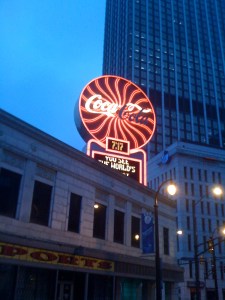
You can see from the digital clock under the giant wheel of Coke that I was passing this sign at 7:17 in the morning. Two days a week I have to be on campus at the break of day to teach a beginning composition course. To reach the building where I teach, I pass this sign, and then I walk through a park that’s a gathering place for many of the city’s homeless. The other day there were two women pushing each other, as if they were playing around, but the mother in me wanted to tell them to stop. I know how that kind of play can get out of hand and lead to punching fights… .
Did you know Atlanta was the world headquarters of the Coca Cola Corporation? They even have a museum called The World of Coca Cola. I’ve never did take my own boys there, but when I taught eighth grade we took the entire class of 100 plus students to this museum. There’s a section of The World of Coca Cola where you can try free samples of Coke products from around the globe. There were exotic fruit flavors and spices, plus Diet Coke, regular Coke, Fanta, you name it. The floor was sticky from spilled Dixie cups of soda. I haven’t been back to the museum in over ten years… I wonder if they have free samples of Dasani? That’s the Coke brand of bottled water. I have a hard time paying for bottled tap water, never mind adding to the proliferation of plastic bottles.
Part of a moon was falling down the west,
Dragging the whole sky with it to the hills.
Its light poured softly in her lap. She saw
And spread her apron to it. She put out her hand
Among the harp-like morning-glory strings,
Taut with the dew from garden bed to eaves,
As if she played unheard the tenderness
That wrought on him beside her in the night.
“Warren,” she said, “he has come home to die:
You needn’t be afraid he’ll leave you this time.”
Julie Buffaloe Yoder has a beautiful, unique image of the moon in her poem “Illusions.” Visit her blog, The Buffaloe Pen, to read it.


 You can see from the digital clock under the giant wheel of Coke that I was passing this sign at 7:17 in the morning. Two days a week I have to be on campus at the break of day to teach a beginning composition course. To reach the building where I teach, I pass this sign, and then I walk through a park that’s a gathering place for many of the city’s homeless. The other day there were two women pushing each other, as if they were playing around, but the mother in me wanted to tell them to stop. I know how that kind of play can get out of hand and lead to punching fights… .
 Balanced On the Edge